Chapter 7 · Video coming soon
Does God Send People to Hell?
Hell isn’t what you were told it was
In this chapter
For many people, hell is the biggest obstacle to believing God is good. But much of what people picture isn’t what Scripture says.
- “Hell” is several different words. English Bibles use “hell” for Sheol and Hades (the realm of the dead), Tartarus (where fallen angels are held), and Gehenna (the final judgment Revelation calls the lake of fire). Before Jesus’ resurrection, the faithful waited in Paradise, “Abraham’s side” (Luke 16:22), while the unrepentant were held in torment.
- Hell is justice for the victimized. A judge who lets an unrepentant murderer walk free isn’t kind; he’s unjust. And no sin is victimless.
- God’s judgment is fair, not one-size-fits-all. Each person is “judged according to what they had done” (Revelation 20:13), and Jesus said judgment would be “more bearable” for some than for others.
- Hell protects the new creation. If people who reject God’s ways were let into heaven, they would ruin it, just as Eden was ruined.
- No one has to go there. The eternal fire was “prepared for the devil and his angels” (Matthew 25:41), not for people, and the door to life is wide open through Jesus.
Key takeaways
- Hell exists because God is just. Without it, there would be no justice for the victimized.
- God’s judgment is fair, not excessive. Each person is judged individually, according to what they have done.
- No one has to go. God is “not wanting anyone to perish” (2 Peter 3:9). As C.S. Lewis put it, “There are only two kinds of people in the end: those who say to God, ‘Thy will be done,’ and those to whom God says, in the end, ‘Thy will be done.’”
Free study guide
Study this episode with your group
Discussion questions, Scripture, and a closing prayer for this chapter, free for any small group.
I know that the concept of Hell deeply troubles many people. For many people, the concept has actually led to great torment and fear. For critics of Christianity, they see injustice in the concept of an eternal punishment for a temporary sin. Many atheists also see it as a form of control. They view it as God pushing His weight around and forcing people to do things His way or burn in Hell if they refuse. To these critics of Christianity, the fact that an all-powerful being would allow human beings to suffer in torment for eternity is proof that God is not good. Many of these critics say they wouldn’t wish that kind of punishment even on their worst enemies… If these assumptions of Hell were accurate, I’d probably agree with them, but there’s a lot more to this story.
Let’s take a closer look at what Hell is, who goes there, why they go there, and what they experience when they go there. I believe that getting to the bottom of these questions will totally transform your paradigm of Hell. If you’ve struggled with fear over the concept of Hell, I am confident our exploration of the topic will bring healing and peace as God’s perfect justice and loving motives behind everything He does, even the creation of Hell, are brought to light.
In this article
What is Hell?
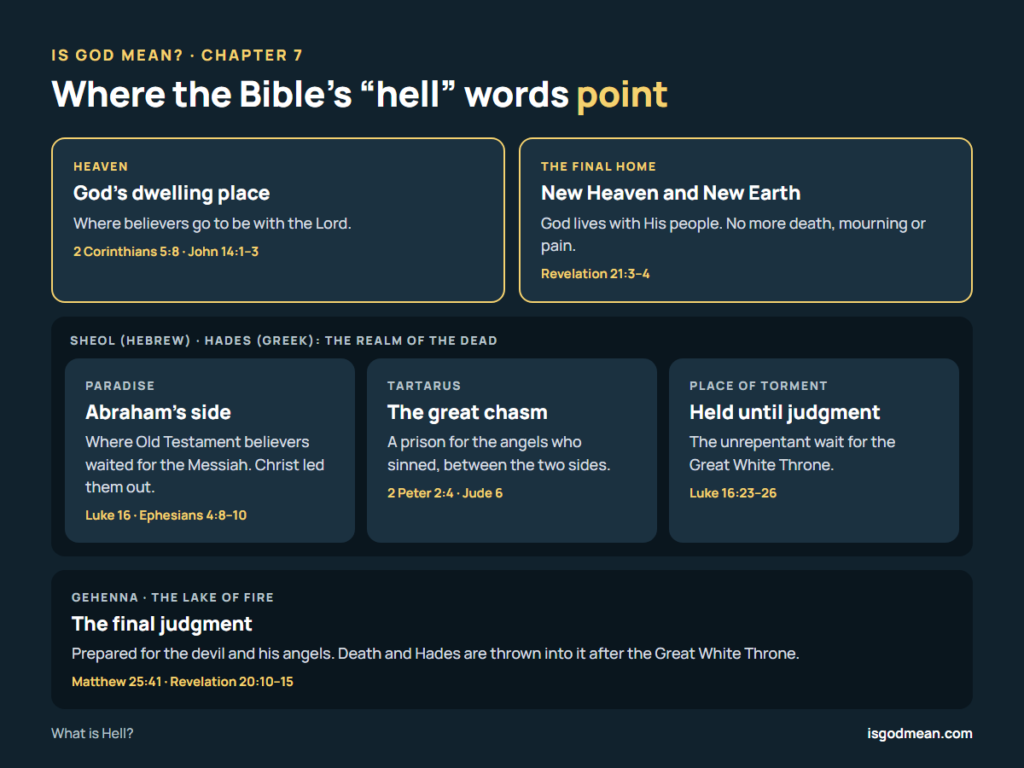
If we’re going to understand how a loving God could send people to Hell, then it’s important that we first have an accurate understanding of what Hell actually is. Our English versions of the Bible translate numerous Greek and Hebrew words as “Hell”. However, in my opinion, that is an oversimplification, as many of the words our English versions of the Bible translate as “hell” actually refer to different locations. Some of the words that get translated simply as Hell are Sheol, Hades, Gehenna, and Tartarus. On top of that, we have references to places like Paradise, the Bosom of Abraham, the Lake of Fire, and Heaven, which also refer to the afterlife. This seems much more complicated than just the Heaven or Hell option that most Christians are aware of. So how do all of the places fit into the story of the afterlife? Let’s break down each one:
Sheol (Hebrew) and Hades (Greek)
In the Old Testament, Sheol was simply the Hebrew word for the grave, or the place of the dead. In the New Testament, Hades was the Greek word for the same place. So Sheol and Hades are the exact same place, just from two different languages. In Sheol/Hades, there are two different sides, each separated by a great chasm between them. Let’s look at the purpose of each side.
Paradise (Abraham’s Bosom)
Before Jesus’ death and resurrection, everyone, including those who followed God, went to Sheol (Hades). However, one side of Hades was called the Bosom of Abraham. This side of Hades was reserved for those who had faith in God.
What does Scripture say? “Abraham believed God, and it was credited to him as righteousness.”
Romans 4:3 (NIV)
In the Old Testament, Christ had not yet paid for the sins of humanity. Therefore, Old Testament believers like Abraham could not yet enter Heaven. However, as we see in the scripture above, their faith was credited to them as righteousness. Therefore, they were granted entrance into Paradise in Hades, but it’s important to note that Paradise is not Heaven; it was a holding place for God’s people who had died while they waited for the Messiah to come. We see this in the parable Jesus shared:
There was a rich man who was dressed in purple and fine linen and lived in luxury every day. At his gate was laid a beggar named Lazarus, covered with sores and longing to eat what fell from the rich man’s table. Even the dogs came and licked his sores.
Luke 16:19-26 (NIV)
“The time came when the beggar died and the angels carried him to Abraham’s side. The rich man also died and was buried. In Hades, where he was in torment, he looked up and saw Abraham far away, with Lazarus by his side. So he called to him, ‘Father Abraham, have pity on me and send Lazarus to dip the tip of his finger in water and cool my tongue, because I am in agony in this fire.’
“But Abraham replied, ‘Son, remember that in your lifetime you received your good things, while Lazarus received bad things, but now he is comforted here and you are in agony. And besides all this, between us and you a great chasm has been set in place, so that those who want to go from here to you cannot, nor can anyone cross over from there to us.’”
Notice it says the beggar, who apparently had faith in God, is taken to Abraham’s side. The KJV version of the Bible says the beggar was taken to “Abraham’s bosom.” This is why the half of Hades reserved for God’s people is sometimes referred to as Abraham’s bosom, the idea being that Abraham embraced those arriving.

Alternatively, the rich man, who apparently did not have faith in God, is taken to a place of torment. This story makes it clear that a great chasm separates Abraham’s bosom and the place of torment. We see the place referenced in this parable as Abraham’s bosom, or Abraham’s side, referenced by the term Paradise in Luke 23:
We are punished justly, for we are getting what our deeds deserve. But this man has done nothing wrong.” Then he said, “Jesus, remember me when you come into your kingdom.” Jesus answered him, “Truly I tell you, today you will be with me in paradise.
Luke 23:41-43 (NIV)
When Jesus was hanging on the cross between two criminals, one expressed faith in Jesus, and Jesus told the man that they would be together in Paradise that day. We know that Jesus went to Hades after He died on the cross, so it seems evident that Jesus and the criminal on the cross both went to Abraham’s bosom in Hades after they died, which was clearly a paradise, as Jesus described it.
Place of Torment
It was also self-evident in the rich man’s description of being in torment in the flames that a place of torment exists across the great chasm in Hades. The rich man described his agony as he was desperate for even one drop of water to cool his tongue. This would be the side of Hades reserved for those who have not made Jesus Christ Lord of their life. So in Hades there is a paradise, and a place of torment, and a great chasm that separates the two. What do we know about this chasm?
Tartarus (The great chasm)
For if God did not spare angels when they sinned, but sent them to hell [Tartarus], putting them in chains of darkness to be held for judgment;
2 Peter 2:4 (NIV)
This verse is the only place in the entire New Testament where the word Tartarus is used, and our English Bibles simply translate it as “Hell”. We looked at this scripture in more detail in the chapter about the Nephilim – the fallen angels who mated with women. This place, often understood as the deepest abyss of Hades, seems to be reserved for the imprisonment of the Nephilim, and I believe it is the great chasm referenced by Abraham when speaking to the rich man about the great chasm separating paradise from the place of torment.
It seems to also be referenced in Jude:
And you know the story of the angels who didn’t stick to their post, abandoning it for other, darker missions. But they are now chained and jailed in a black hole until the great Judgment Day.
Jude 1:6 (MSG)
It also seems to be what the demons were afraid of when speaking with Jesus:
Jesus asked him, “What is your name?” “Legion,” he replied, because many demons had gone into him. And they begged Jesus repeatedly not to order them to go into the Abyss.
Luke 8:30-31 (NIV)
So when the Bible speaks of Hades, it could actually be referencing one of three different places depending on the context. Either Paradise for the Old Testament saints, the place of torment for those who have not been counted righteous, or the great chasm in between the two that has been reserved as a prison for fallen angels.
Gehenna (The lake of fire)
Another word we see translated as “hell” in the New Testament is Gehenna. Gehenna appears to be a different place from Hades, and is presented as a place of judgment. Gehenna refers to the Hebrew word Ge-Hinnom, which means “Valley of [the sons of] Hinnom.” Ge-Hinnom was a valley outside Jerusalem that had been used by some of Judah’s ancient kings to burn children alive as a sacrifice to the pagan god Molech.
God’s prophet Jeremiah confronted these barbaric and murderous kings of Judah by saying that God was going to send enemy nations to conquer Jerusalem and destroy the city with fire (Jer 21:10). In this way, God stated that Jerusalem was going to be defiled in the same way Ge-Hinnom had been (Jer. 19:12-13). The idea was that in the very way these evil kings had created fire to burn the innocent, fire would now consume their own wickedness. God renamed Ge-Hinnom to The Valley of Slaughter, as there would not even be room to bury everyone in Ge-Hinnom once God’s judgment arrived (Jer. 7:30-34). In this sense, Ge-Hinnom represents a type of justice and God’s way of purging evil from God’s good creation.
A later Jewish tradition, first recorded around AD 1200, holds that in Jesus’ day the fires of Ge-Hinnom still burned, but in a different way. In this tradition, the valley had been repurposed into an ever-burning garbage dump, an incinerator where they kept the fire always burning in order to consume the garbage from the city. They would burn the corpses of criminals, dead animals, and all manner of refuse. One can imagine that the area was infested with maggots and worms, and was likely permeated by a thick, nauseating smoke. It would have been an overwhelmingly repulsive and revolting place, both to see and to smell.
Because of its consuming nature and ancient use as a symbol of God’s justice and eradication of evil, Jesus used Gehenna as a powerful metaphor for hell—a realm where the flames never die, and worms are never absent (Matthew 10:28; Mark 9:47–48).
And if your eye causes you to sin, tear it out. It is better for you to enter the kingdom of God with one eye than with two eyes to be thrown into hell [Gehenna], ‘where their worm does not die and the fire is not quenched.’
Mark 9:47-48 (ESV)
Other similar New Testament verses referencing Gehenna are Matthew 5:22, Matthew 5:29, Matthew 5:30, Matthew 10:28, Matthew 18:9, Matthew 23:15, Matthew 23:33, Mark 9:43, Mark 9:45, Mark 9:47, Luke 12:5, and James 3:6.
As you can see through these scriptures, Jesus used Gehenna as a metaphor for a place of eternal judgment and destruction. While Jesus was teaching, He stated that the eternal fire had been prepared for the devil and his angels:
Then he will say to those on his left, ‘Depart from me, you who are cursed, into the eternal fire prepared for the devil and his angels.
Matthew 25:41 (NIV)
We again see a reference to this place of eternal fire, now referenced as the “lake of fire”, in the book of Revelation:
and the devil who had deceived them was thrown into the lake of fire and sulfur where the beast and the false prophet were, and they will be tormented day and night forever and ever.
Revelation 20:10 (ESV)
The passage then goes on to describe the White Throne Judgment, and how Hades, still holding anyone whose name was not written in the Lamb’s Book of Life, will be thrown into the lake of fire as well:
Then I saw a great white throne and him who was seated on it. The earth and the heavens fled from his presence, and there was no place for them. And I saw the dead, great and small, standing before the throne, and books were opened. Another book was opened, which is the book of life. The dead were judged according to what they had done as recorded in the books. The sea gave up the dead that were in it, and death and Hades gave up the dead that were in them, and each person was judged according to what they had done. Then death and Hades were thrown into the lake of fire. The lake of fire is the second death. Anyone whose name was not found written in the book of life was thrown into the lake of fire.
Revelation 20:11-15 (NIV)
Now that we’ve reviewed all of the different words translated as “Hell” in our English Bibles, let’s take a quick look at the happy alternative to Hell.
Heaven
I’m sure the majority of people reading this are already familiar with the concept of Heaven, so I don’t believe much explanation is necessary, but I’ll provide a brief one so that we are all on the same page.
Heaven is God’s dwelling place, and it is the destination of saints who have made Jesus Christ the Lord of their lives, as well as the current residence of Old Testament saints who died trusting God’s promise of a coming redeemer:
For God so loved the world, that he gave his only Son, that whoever believes in him should not perish but have eternal life.
John 3:16 (ESV)
While Jesus was on earth, He told his disciples that He was going to prepare a place for them in His Father’s house:
Let not your hearts be troubled. Believe in God; believe also in me. In my Father’s house are many rooms. If it were not so, would I have told you that I go to prepare a place for you? And if I go and prepare a place for you, I will come again and will take you to myself, that where I am you may be also.
John 14:1-3 (ESV)
The Bible also speaks of a New Heaven and a New Earth where the children of God will dwell together with God and Jesus forever in bliss:
And I heard a loud voice from the throne saying, “Look! God’s dwelling place is now among the people, and he will dwell with them. They will be his people, and God himself will be with them and be their God. ‘He will wipe every tear from their eyes. There will be no more death’ or mourning or crying or pain, for the old order of things has passed away.”
Revelation 21:3-4 (NIV)
There’s a lot we could say about Heaven, as the Bible, and even Jesus Himself, spoke about it a lot. It is truly a place so marvelous and wonderful that our minds can not yet comprehend it:
However, as it is written: “What no eye has seen, what no ear has heard, and what no human mind has conceived” —the things God has prepared for those who love him—
1 Corinthians 2:9 (NIV)
So what happens when we die?
So the Bible tells us that human beings are destined to die once:
Just as people are destined to die once, and after that to face judgment,
Hebrews 9:27 (NIV)
Notice it says that after death is when we face judgment; this implies that the physical death of our bodies is not the end of our existence, but that there is more to come. What does that look like?
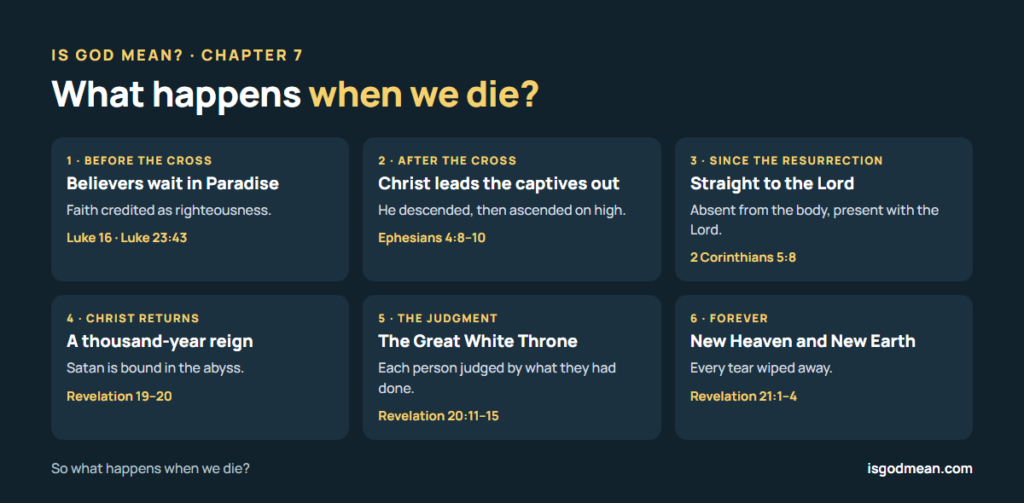
In the Old Testament, it was a little different for believers than it is now. Because Jesus had not yet come to earth to pay the price for our sin, Old Testament believers didn’t yet go to Heaven when they died. However, as we already covered earlier, when a person living under the old covenant died believing God’s promises, it was counted unto them as righteousness (Romans 4:3).
Due to their faith in God, they would then be taken to paradise in Hades, just as we saw in the parable of the rich man and Lazarus (Luke 16:19-26), and with the criminal on the cross who expressed his faith in Jesus and was guaranteed a spot in paradise by Christ Himself (Luke 23:41-43).
After Christ’s physical death on the cross, many scholars believe Jesus then descended to Hades, where He made a proclamation of His victory over sin and death, and then led the saints held captive in Paradise on a triumphant march out of Hades and into Heaven. They come to this conclusion based on the following three scriptures:
Christ suffered for our sins once for all time. He never sinned, but he died for sinners to bring you safely home to God. He suffered physical death, but he was raised to life in the Spirit. So he went and preached to the spirits in prison— those who disobeyed God long ago when God waited patiently while Noah was building his boat. Only eight people were saved from drowning in that terrible flood.
1 Peter 3:18-20 (NLT)
This scripture clearly tells us that after Christ died physically, His spirit preached to disobedient spirits from Noah’s era. This is why many believe He was making a victorious proclamation over sin and death to those in Hades. Then, due to the following verse, many believe that Christ proceeded to lead the saints out of Paradise and into Heaven:
Therefore He says:
Ephesians 4:8-10 (NKJV)
“When He ascended on high,
He led captivity captive,
And gave gifts to men.”
(Now this, “He ascended”—what does it mean but that He also first descended into the lower parts of the earth? He who descended is also the One who ascended far above all the heavens, that He might fill all things).
Many scholars interpret “He led captivity captive” from this verse to mean that he captured the souls held captive in Paradise and led them to Heaven. This scripture goes out of its way to highlight that Christ had descended into the “lower parts of the earth.” Which, in Jesus’ day, was widely understood to be the realm of the dead (Hades), and the Hebrew equivalent phrase was used in the Old Testament as such. Finally, we see this idea of Christ descending into Hades once again backed up by this verse:
For as Jonah was in the belly of the great fish for three days and three nights, so will the Son of Man be in the heart of the earth for three days and three nights.
Matthew 12:40 (NLT)
Once again, many understand the phrase “heart of the earth” as a metaphorical representation of the realm of the dead (Hades), and since we know that Jesus was preaching to souls in prison after His body died on the cross, this makes sense.
Now, the only souls left in Hades are those in the place of torment, as everyone who was in Paradise was taken by Christ to Heaven after His resurrection. The place of torment is the place where unrepentant sinners who died, either under the Old Covenant or the New Covenant, are held until the Great White Throne Judgment. After the Great White Throne Judgment, Hades will be emptied, and everyone previously held there will perish in the Lake of Fire.
Then I saw a great white throne and him who was seated on it. The earth and the heavens fled from his presence, and there was no place for them. And I saw the dead, great and small, standing before the throne, and books were opened. Another book was opened, which is the book of life. The dead were judged according to what they had done as recorded in the books. The sea gave up the dead that were in it, and death and Hades gave up the dead that were in them, and each person was judged according to what they had done. Then death and Hades were thrown into the lake of fire. The lake of fire is the second death. Anyone whose name was not found written in the book of life was thrown into the lake of fire.
Revelation 20:11-15 (NIV)
What about New Testament Christians who die?
For every Christ-follower who has died or who will die after Christ’s resurrection, they will enter immediately into Heaven to be in the presence of the Lord.
We are confident, I say, and willing rather to be absent from the body, and to be present with the Lord.
2 Corinthians 5:8 (KJV)
The last few chapters of the book of Revelation lay out the timeline for the future of God’s kingdom and His people. After the tribulation takes place on earth, Christ and the armies of Heaven will leave Heaven to return to earth (Revelation 19:11-16). Upon Christ’s second arrival to earth, the Beast and the False Prophet will be thrown into the Lake of Fire, and Satan will be locked in the great abyss in Hades (Revelation 19:20, 20:2-3). Christ will begin a millennial reign on the earth, where He will resurrect those who were martyred during the tribulation to reign with Him during His one thousand years on earth (Revelation 20:4, 2 Timothy 2:12).
At the end of the millennial reign, Satan will be released to lead the final rebellion against God. Satan’s rebellion will fail, and he will be defeated and cast into the Lake of Fire. Then, God will judge the dead at the Great White Throne judgment. Afterward, anyone whose name was not found in the Book of Life will also be thrown into the Lake of Fire (Revelation 20:7-13).
Those found in the Lamb’s Book of Life will enjoy the unimaginable privilege of getting to witness the entrance of the New Heaven and the New Earth (Revelation 21:1, 2 Peter 3:12-13). Jesus’ disciples will be given the honor of governing with Christ, and everyone who sacrificed during their life on earth for the sake of Christ will be given one hundred times anything they gave up as they inherit eternal life. Faithful followers of Christ who were deemed unimportant in their life on earth will be made great in the new kingdom (Matthew 19:28-30).
The New Heaven and the New Earth are the final known destination of God and His people. We are given a beautiful glimpse into what life will be like for us in this new realm:
I heard a loud shout from the throne, saying, “Look, God’s home is now among his people! He will live with them, and they will be his people. God himself will be with them. He will wipe every tear from their eyes, and there will be no more death or sorrow or crying or pain. All these things are gone forever.”
Revelation 21:3-4 (NLT)
The Bible doesn’t allow us to peek into the future beyond this point, but you can rest assured that an eternity at Christ’s side in His glorious New Heaven and New Earth will be far beyond your wildest dreams.
That is what the Scriptures mean when they say, “No eye has seen, no ear has heard, and no mind has imagined what God has prepared for those who love him.”
1 Corinthians 2:9 (NLT)
Is God’s treatment of the unrepentant just, or overkill?
Now let’s get to the heart of the matter. The issue that actually causes friction for those trying to reconcile an all-loving God with the concept of Hell is the question of just punishment. Is God’s severe punishment of the wicked fair, or is it violently extreme? In order to help us more clearly understand God’s judgments, let’s consider what we expect from a righteous judge here on earth.
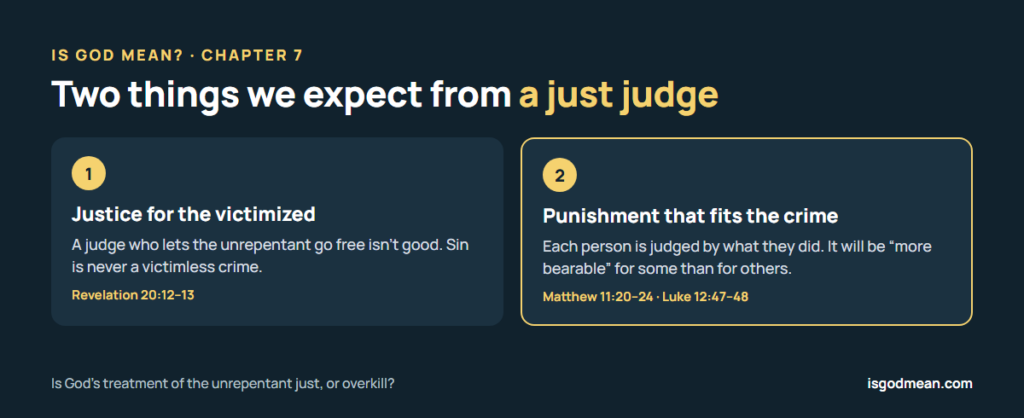
In order for a judge to be just, we’d expect him to do two things: One, secure justice for the victimized, and two, apply accurate punishment for the crime. Let’s look at each of those points individually as they relate to God.
Does God secure justice for the victimized?
If a criminal broke into your house and murdered your family while they slept, would you want the murderer to face justice? If the murderer showed no remorse or desire to repent, would you be angry if the judge released him with no punishment? Would that be just? Would that be moral? No, something deep inside of us would find this lack of justice revolting and even evil.
The same goes for God. If God allowed unrepentant thieves, rapists, murderers, and the like to go free with no punishment, He would not be a just judge. We would find his refusal to secure justice for the victimized revolting and evil. If the Hitlers of the world are allowed to go unpunished, then when would the abused and victimized ever find closure and solace?
The problem is, most people are fine with the concept of Hitler going to Hell, but it’s the idea of their family, friends, or even themselves going to Hell that angers them. They think of themselves and their friends as basically good people, but the truth is that everyone has sinned, and sin is not a victimless crime.
It’s easy to dismiss our sins as no big deal, but if we asked the victims of our sins whether we were innocent, I believe we’d get a very different answer. That boss that you steal from by surfing social media for hours at a time while you’re on the clock – the bullied kid you made fun of in high school because it was what everyone else was doing – the woman who was trafficked or manipulated into producing porn because of the demand of viewers – or maybe that old friend whose reputation was tarnished when you spread biased gossip because you were jealous – are these truly the actions of an innocent person? I’m not picking on you. We’ve all hurt others, and we’ve all hurt God. We’re all in the same boat.
My point is simply that none of us are truly innocent. If we are being intellectually honest, I believe that every single one of us would have to admit that at some level, we are all deserving of judgment. All of us know that we’re not perfect and have done wrong, but where people struggle with a sense of injustice is the intensity of the judgment. I think the problem for most people is that they perceive that the punishment doesn’t match the crime. Does someone really deserve to burn in hell for eternity because they stole some time from their boss by surfing social media during work hours?
Obviously, all of us have done a lot more than surf social media while at work. We know that doesn’t even begin to scratch the surface of our guilt. A lot of apologists go the route of pointing out how drastically humanity whitewashes its own sin and belittles its harmful effects on the world, and I think that is a legitimate route to take. I could dive deep into that topic and make some powerful, perspective-changing arguments.
However, that is not the route I want to take in this book, because I can understand why someone would question the fairness of eternal conscious torment. Is an eternity of conscious torment truly always the just punishment for a person’s temporal sins?
Does God apply equivalent and fair punishment for the crime?
We know that the Bible teaches, rather than a blanket judgment for all mankind, that each person will be judged individually for the life they lived:
The sea gave up the dead that were in it, and death and Hades gave up the dead that were in them, and each person was judged according to what they had done.
Revelation 20:13 (NIV)
This is a perspective-shifting point that many people pass over. We will all be judged individually for the life we’ve lived, and the punishment that unbelievers experience in Hades will be unique according to what they individually deserve. Jesus’ words in the Bible suggest that everyone’s punishment on the day of Judgment will be different depending on how they lived:
Next Jesus unleashed on the cities where he had worked the hardest but whose people had responded the least, shrugging their shoulders and going their own way. “Doom to you, Chorazin! Doom, Bethsaida! If Tyre and Sidon had seen half of the powerful miracles you have seen, they would have been on their knees in a minute. At Judgment Day they’ll get off easy compared to you. And Capernaum! With all your peacock strutting, you are going to end up in the abyss. If the people of Sodom had had your chances, the city would still be around. At Judgment Day they’ll get off easy compared to you.”
Matthew 11:20-24 (MSG)
Notice that the scripture states that cities like Chorazin, Bethsaida, and Capernaum will be judged more harshly on Judgment Day compared to Tyre, Sidon, and Sodom because of their hard-heartedness. Other translations say that it will be more “bearable”, “tolerable”, and “endurable” for Tyre, Sidon, and Sodom on judgment day than it will be for Chorazin, Bethsaida, and Capernaum. This obviously suggests that these cities will be judged differently, with more or less bearable outcomes on judgment day depending on what they deserve.
So it does seem that God adjusts the punishment to fit the crime. We see this idea reiterated by Jesus again in the parable of the manager and the servant:
“The servant who knows what his master wants and ignores it, or insolently does whatever he pleases, will be thoroughly thrashed. But if he does a poor job through ignorance, he’ll get off with a slap on the hand. Great gifts mean great responsibilities; greater gifts, greater responsibilities!
Luke 12:47-48 (MSG)
Once again, Jesus uses this parable to highlight the idea that a person will be judged fairly and receive punishment that justly matches their sins. I think we make a mistake when we assume that everyone’s experience in Hades is identical. Based on the words of Jesus, it seems that each person’s experience will be uniquely tailored to what they deserve.
Does God allow suffering to last for eternity?
Annihilationism is the belief that those who are cast into the Lake of Fire will not suffer eternally, but will, quite literally, be annihilated and simply cease to exist. Annihilationists believe that even the time an unbeliever spends in the Lake of Fire is a temporal punishment, not an everlasting one. Although the annihilationist view of Hell has been around since the days of the church fathers, growing up in the conservative evangelical circles that I run in, I had never heard it. It wasn’t until recently that this doctrine started to grow in popularity in modern mainstream evangelical circles.
I’m not saying that the annihilationist position is the correct position. There are strong, scripture-based arguments both for and against annihilationism. I will say that as I’ve looked closer into the doctrine, I’ve been surprised to find that the foundation for the belief is actually rooted in plain readings of Scripture, not in blind emotionalism as I first assumed. However, there are still some strong arguments supporting the eternal conscious torment position as well.
That being said, your beliefs should not be based on blind acceptance of a doctrine passed down to you, but should be based on scriptural study guided by the Holy Spirit. I don’t want to attempt to tell you what to believe; I simply want to provide you with a launching point to begin your own study as you let the Holy Spirit guide you into all truth. At the very least, in a skeptical world beginning to ask questions about this topic, we should study to show ourselves approved, armed with God-revealed answers, not hand-me-down, zero-effort dismissive responses.
So let’s take a quick look at this doctrine currently at the center of so much discussion and controversy. My goal is not to convince you of its truth, but rather to introduce you to it and make you aware of its existence. I’ll share its basic premise with you, and I’ll let you and the Holy Spirit take it from there to draw your own conclusions.
The annihilationist view is based on three core ideas:
One: The New Testament talks about the fate of fallen, unrepentant humanity using language that suggests finality.
Two: Humans are not inherently immortal but receive immortality as a gift from God upon believing in Christ.
Three: The eternal punishment described by Jesus portrays the eternal result of the punishment, not the eternal act of punishing. The wicked’s destruction is eternal, final, and cannot be reversed.
A closer look at John 3:16
One of the most famous scriptures in the world, John 3:16, does a great job illustrating these points. Most of us have the scripture memorized, but it’s worth taking a second look.
For God so loved the world that he gave his one and only Son, that whoever believes in him shall not perish but have eternal life.
John 3:16 (NIV)
Notice that it suggests that those who don’t believe in Christ shall perish, not suffer eternally. The word translated as perish in the Greek suggests finality. To destroy, kill, lose, etc. Those of us, like myself, who have a traditional, conservative background find it completely natural to interpret that word in a metaphorical sense, assuming that to perish means to burn eternally in Hell. However, I don’t believe the language itself suggests that idea. That is something that we have read into it.
The language itself, to my understanding, suggests a final end – a death. A death that lasts for all eternity. Since other places in scripture refer to the lake of fire as “the second death” (Revelation 20:14, 21:8), this understanding seems biblically consistent.
Notice that this scripture also seems to suggest that only those who believe in Christ will inherit eternal life. Those who don’t believe simply perish. The idea that humanity is not inherently immortal and that eternal life can only be found through Jesus Christ appears in many other scriptures (1 Corinthians 15:21-22, 50-54; 2 Timothy 1:10).
Plus, remember that in the early days of the human race, eternal life was contingent on eating from the tree of life (Genesis 2), which is why Adam and Eve had to be removed from the Garden. Revelation 22 reveals that the tree of life will once again be available only to those who dwell in the New Jerusalem, as their names are recorded in the Lamb’s Book of Life.
It is worth noting here, once again, that Matthew 25:41 tells us the Lake of Fire was not made for humanity, but for Satan and his angels. Unlike humanity, Satan and his angels are inherently eternal beings who are not perishable. As such, Revelation 20:10 states they will be tormented in the Lake of Fire for eternity. So, as a point of understanding, the Lake of Fire will last for eternity, and there will be eternal torment happening in the Lake of Fire, but not for humanity. At least, that’s the way those who subscribe to the belief of partial annihilationism understand it.
The implications of annihilationism
Our look into John 3:16 provides a sneak peek into the paradigm through which annihilationists interpret the Scriptures, but why is it important to our topic? Because if annihilationism, or partial annihilationism, is accurate, then people don’t suffer for eternity for temporal sins. It highlights that God’s judgments are just, not excessive. Once again highlighting God’s goodness. He secures justice for the victimized while applying just judgments for the guilty – everything we’d expect from a good and moral judge.
Either way, whether people eventually perish in the Lake of Fire or not, one thing is clear: rather than a blanket punishment for all, God makes sure that each person’s punishment justly and uniquely matches their crime. That is one thing that all believers can agree on.
The real reason people go to Hell
So far we’ve looked at what Hell is, who goes there, and what they experience when they go there, but probably the biggest question of all is why do people go there. For people questioning the goodness of God, the most difficult question is why would a perfectly good God ever make Hell an option in the first place?
In the book of James in the New Testament, it says:
The tongue also is a fire, a world of evil among the parts of the body. It corrupts the whole body, sets the whole course of one’s life on fire, and is itself set on fire by hell.
James 3:6 (NIV)
Notice that this scripture says that the tongue is set on fire by Hell, thus highlighting the potential effect that Hell can have even on our life on earth. This comes as no surprise, though, as all of us are familiar with the concept of Hell on Earth.
Most of us have encountered people who have described their life as being a living Hell. While doing outreach ministry, I’ve personally met people who told me that their life was already Hell on Earth, and they couldn’t imagine how death could possibly be any worse. I believe their words were a very accurate and fair description of how they were feeling. The Bible tells us:
For the wages of sin is death…
Romans 6:23 (KJV)
Sin and evil bring death, destruction, and pain. God hates sin because of the Hell it creates on earth for His beloved creations. He hates the suffering and pain that people bring on themselves when they choose to rebel against the way of life they were created for.
God gives rules and creates boundaries for the same reason that a parent creates rules and boundaries for their child. I don’t allow my daughter to play in the street because I know it’s dangerous and would lead to her getting badly hurt. I have no desire to limit her fun or to control her simply to show off my power over her. I just want to protect her. In the same way, God has called us to live within the bounds that He knows will keep us safe, happy, healthy, and thriving. He knows that living according to His rules not only protects us, but also those around us who could also become victims of our sin.
Do we hate Hell enough?
Let’s put this into terms that we can all relate to. There is no one reading this that would deny that the sexual exploitation of children for profit is heinously evil. No one reading this would deny that the victims of child sex trafficking experience Hell on earth. We hate that Hell, but Jesus hates it even more.
We hate it enough to arrest and lock up the perpetrators of these crimes after they’ve been found guilty, but Jesus hates it so much that He wants to eradicate it before it ever happens to begin with. So, in His effort to protect His creation from the Hell of sex trafficking, He makes even lusting after a woman in your heart a sin. He knows that this is the gateway, the first step, towards sexual immorality. He knows that if the fires of sexual immorality are left unchecked, they eventually lead to child sex trafficking and a myriad of other forms of Hell on earth, like rape and abuse.
Christ calls His followers to submit even their eyes and imaginations to His Lordship and to immediately repent when their actions take even just the very first step towards this vile and destructive Hell on earth.
Another example that we can all agree with is that racism, violence, and murder are all abhorrent actions that we’d condemn wholeheartedly… and yet, there are few people who would say that they’ve never experienced hatred in their heart. Some even embrace the hatred and feel they are entitled to it, and that it is their right due to the injustices they have suffered, but the Bible says:
Anyone who hates a brother or sister is a murderer, and you know that no murderer has eternal life residing in him.
1 John 3:15 (NIV)
This idea is expanded on in Matthew 5:21-22:
You have heard that it was said to the people long ago, ‘You shall not murder, and anyone who murders will be subject to judgment.’ But I tell you that anyone who is angry with a brother or sister will be subject to judgment. Again, anyone who says to a brother or sister, ‘Raca,’ is answerable to the court. And anyone who says, ‘You fool!’ will be in danger of the fire of hell.
Matthew 5:21-22 (NIV)
Why does the Bible equate harboring hate in your heart, or even just being angry, to murder? Because hatred is the gateway, the first step, towards murder. Without hate in someone’s heart, there would be no racism, no violence, and no murder. Thus, Jesus calls everyone who calls Him Lord to repent of their hatred, not even tolerating the first step towards murder to be overlooked. For those who seek to be a part of His kingdom, He has a zero-tolerance policy for anything that creates a path to Hell on earth. We are allowed to make mistakes, but those mistakes are never condoned, approved, or overlooked. We must repent.
I could keep going with many more examples, but I think you get the point. Things that we often view as small, insignificant issues, like lust, anger, or hatred, are actually big deals to God as they expose His creation to torturous Hell on Earth. These sins are not victimless as many claim, but actually lead to a vast multitude of victims.
The eternal bliss to come
God understood that true love requires true choice. He could have made us all robots and not allowed us the gift to truly choose Him, but He opted to make us in His image, with His emotions, and with the capability to love like Him! This was a priceless gift to us. Without it, we would never have been able to experience the bliss of sincere love. However, choosing to give humanity a truly free will also gave us the freedom to reject Him and His ways. As we all know, many people have done this, and it has led to many pockets of Hell on Earth and a vast sea of suffering victims.
In spite of the great suffering that exists in this world, those who choose to submit to the Lordship of Jesus Christ have an unshakeable hope, as we have been promised an eternity in the life to come where our joy will know no bounds.
He will wipe every tear from their eyes. There will be no more death or mourning or crying or pain, for the old order of things has passed away.”
Revelation 21:4 (NIV)
The need for Hell
What’s interesting about Heaven is that everyone there will still continue to have free will. Although we’ll no longer have the temptation and influence of our carnal nature, making it easy for us to live and act the way we truly desire as friends and children of God, reveling in God’s ways and plan… but what about all the people who genuinely don’t want things God’s way? What about all the people who despise the Lord for His demand to adhere to His ways in order to partake in the Kingdom of Heaven? What about all of the people who ignore, reject, and rebel against the commands given to humanity in the Bible?
Remember, the instructions given to us in the Bible are there to protect us and prevent sin and evil from destroying God’s good world and corrupting it into a hellish environment. The same will be true of Heaven and the New Earth. If God were to allow everyone into Heaven, even those who reject God’s ways, it would cease to be a good place. The seeds of Hell that live in everyone who rebels against the righteous and just commands of God would eventually blossom into full-blown destruction and suffering. Unchecked lust would eventually mature into abuse. Unchecked anger and hatred would eventually mature into violence, and the beautiful utopian experience that God has promised all those who have submitted to His Lordship would be destroyed, just like Eden was.
Would you allow someone to move into your home if you knew that eventually they were going to hurt your family? Of course not, so why would you expect God to have an even lesser morality than you? This is why not everyone can be allowed into Heaven, and the reason why Hell exists. No one is forced to go to Hell. The door is wide open to anyone willing to accept the free gift that Christ provided by taking their punishment on the cross, but the entire family of God will not be put at risk due to those who refuse to turn away from wickedness and evil. As C.S. Lewis says in The Great Divorce, “There are only two kinds of people in the end: those who say to God, ‘Thy will be done,’ and those to whom God says, in the end, ‘Thy will be done.’”
God’s loving motives for creating Hell
There are four main points that I hope stick with you from this chapter.
1. Without Hell, there would be no justice for the victimized.
For those who don’t receive justice on this earth for crimes done against them, or for those whom our means of punishment on earth lack the ability to provide true justice, Hell provides justice for victims that can be found no other way – both for the ‘crimes’ committed against us by fallen angels and by wicked humans. To not provide justice for victims is heartless, cruel, and just plain evil. Any good judge, as God is, would seek justice for victims.
2. God’s judgments are fair and just, not excessive.
As we discussed earlier, each person (or spiritual entity) is judged individually for what they’ve done, and the punishment they receive is unique to their crimes. Everyone’s experience in Hell is not the same. Some even believe that once justice has been met, they will be annihilated and their suffering will be ended.
3. Without Hell, there would be no protection for God’s people in the new heaven and new earth.
If Hell didn’t exist, then Satan, his fallen angels, and humans who have rebelled against God would be free to once again corrupt the new perfect world that God is going to create. In the new world, there will be no more pain and no more sadness, but if Satan and all of those he deceived were still free, they would corrupt creation again. Therefore, keeping the wicked imprisoned in Hell ensures the new heaven and new earth will remain an eternally blissful home for the redeemed.
4. Every person has the free choice to go to heaven. No one has to go to hell.
We will never be able to fathom the sacrifice that was made when our all-powerful King Jesus left the glory of heaven to come to this earth just to die a criminal’s death in our place. He did all the hard work for us. All we have to do is accept Christ’s free gift, turn our back on the evil things that are hurting us and hurting our fellow man, and exchange it for the life-filled, joy-giving practices of His kingdom. We have nothing to lose and everything to gain.
When you take all of this into account, I believe the right question is not, “How could a loving God send people to Hell?” but “How could you reject a perfectly loving God who sent his own son to die in your place so you could live forever?”
Take it further
Get the free Is God Mean? study guide
A small-group session for every chapter, with discussion questions, Scripture and prayer. Sign up and you’ll be the first to know when the book releases.