Chapter 6 · Video coming soon
Is the Bible Sexist? What God Really Thinks About Women
How Scripture elevated women in a world that didn’t
In this chapter
The Bible has been used to put women down, and many women have quietly wondered whether God sees them as equal. Chris believes the Bible is the most powerful source of women’s worth anywhere.
- Equal image bearers. From the first chapter, “male and female he created them” in God’s image (Genesis 1:27). A woman’s worth isn’t earned by her looks, her children, or her career; it’s given by God, so no one can take it away.
- “Helper” is a word of strength. The Hebrew word for Eve as Adam’s “helper” (‘ezer) is used most often for God Himself coming to rescue His people. It describes a powerful ally, not a subordinate.
- God’s law protected women, and Jesus honored them. In a world that treated women as property, Jesus spoke with them in public, taught them as disciples, and chose women as the first to hear He was the Messiah and the first witnesses of His resurrection.
- Equal worth, different roles. Chris believes God gives husbands and wives different roles in marriage, just as the Father and Son have different roles while being equally God. Biblical submission is mutual: wives respect their husbands’ leadership, and husbands lay down their lives for their wives.
- The hard passages have a context. Chris walks through polygamy, Deuteronomy 22:28–29, 1 Timothy 2, and 1 Corinthians 14 and finds God’s protection of women in each.
Key takeaways
- Women and men equally bear God’s image. A woman’s worth is given by God, not earned, so it can never be taken away.
- Jesus revolutionized how women were treated. He defended, taught, healed, and trusted women when his culture refused to.
- Different roles never mean different worth. Biblical submission is mutual and looks like Jesus: self-giving love, not control.
Free study guide
Study this episode with your group
Discussion questions, Scripture, and a closing prayer for this chapter, free for any small group.
If you’re a woman, has the seemingly sexist content in the Bible left you questioning if you matter to God and if He sees you as equal with men? There’s no denying that the Bible has been used by many to justify sexism, both throughout history and also in current times. This has led many women to wrestle with doubt as they scour the scriptures for evidence that God values and cherishes them.
This is understandable when you consider the controversial passages in the Bible surrounding the treatment of women. For example, what about the seemingly sexist legal codes instructing women to keep silent in church and submit to their husbands? Why are otherwise righteous men so often recorded in the scriptures as having polygamous marriages? Does the Bible actually command a woman to marry her rapist?
These are important questions to be asking, and all questions that we’re going to be answering in this chapter. These questions are important because it’s impossible to be comfortable in a relationship with someone if you are insecure about how they see you and if they recognize your worth. It would be terrifying to trust and submit to the leadership of someone you are unsure has your best interests in mind, and since all of us are called to submit to the lordship of Jesus Christ, it is critically important that men and women both know where we stand with God. Not to mention, men and women alike need to know how to process the very serious accusations that the God we serve condoned the subjugation and objectification of women.
Let’s take a deep dive into some of the most challenging portions of Scripture as we work to uncover God’s true heart towards women.
In this article
- Woman’s origin story
- Man vs. Woman
- Christianity a woman’s religion?
- Jesus, defender of women
- Roles of powerful women in the Bible
- Men and women – equal but different
- The S Word
- Does God endorse the rampant polygamy in the Bible?
- Marry your rapist?
- Did Paul forbid women to teach in church?
- Why did Paul command women to stay silent in church?
Woman’s origin story
The good news is that not only do I believe the Bible is not sexist, but I believe it is the single most empowering source of equality for women, with the most powerful evidence of the innate worth of women that you will find anywhere on the planet. The Bible makes it clear that God equally treasures women and values the critically important role they play in His family.
You have to look no further than the creation of woman in Genesis 1 to find clear and unmistakable evidence for this. In the very first chapter of the very first book of the Bible we find the first mention of the creation of woman, and it is a pretty glorious introduction:
Then God said, “Let us make mankind in our image, in our likeness, so that they may rule over the fish in the sea and the birds in the sky, over the livestock and all the wild animals, and over all the creatures that move along the ground.”
Genesis 1:26-27 (NIV)
So God created mankind in his own image,
in the image of God he created them;
male and female he created them.
The biblical author, under the divine inspiration of God, goes out of his way to highlight that both male and female were created in God’s image and likeness. There is no greater honor or measure of value anywhere in the universe, for both men and women, than to have been created in the image and likeness of God. Men and women have equally been given an innate worth as God’s image bearers that nothing and no one can take from us. The case for the value of women, and men, is the same; the only reasonable explanation for the worth and value of mankind is that our worth was bestowed on us by God.
No other worldview offers an acceptable answer to where the value of women comes from. There are some cults that place the value of women on how many babies they have, but what if a woman never has a baby? Does that mean she’s not valuable? Modern media and entertainment place a woman’s value in how attractive and sexually desirable she is. This objectifies women and demeans them to nothing more than a pleasure factory for men. The feminist camp values a woman’s status, financial success, business prowess, and influence. Does that mean that a woman who wants to be a stay-at-home mom is less valuable than the CEO?
Other than the Bible, all suggested sources of value for women fall short and exclude or include women based on certain metrics or their performance. This is not representative of the innate sense of worth that all women truly possess. In order for every woman to be valuable, her value must be intrinsic; and it is, as her value has been bestowed on her by God, and is not a reward of her performance or appearance. Men and women are equal image bearers of God, each one carrying different, but equal aspects of His nature.
Man vs. Woman
In this chapter, we are going to jump into some of the difficult passages of scripture that are often used to justify misogyny, but before we do that, I first want to continue to lay some groundwork on the overall idea of God’s view towards women and some common misconceptions that have led some to believe that the Bible insinuates that men are superior to women. I do believe that men and women have different roles, as each represents a different facet of God’s nature and character. However, I do not believe that either man or woman is superior to the other, but that we are both equals in the sight of God. Paul said in the book of Galatians:
So in Christ Jesus you are all children of God through faith, for all of you who were baptized into Christ have clothed yourselves with Christ. There is neither Jew nor Gentile, neither slave nor free, nor is there male and female, for you are all one in Christ Jesus. If you belong to Christ, then you are Abraham’s seed, and heirs according to the promise.
Galatians 3:26-29 (NIV)
This scripture is not saying that we lose our identity as males or females, but simply and beautifully that we are all equally heirs according to God’s promise. We are all one, and equally children of God. Unfortunately, some look at the story of the creation of Adam and Eve and their time in the Garden of Eden and wrongly conclude that man was created to be superior to women. Let’s look at some of those arguments and break them down.
False argument 1: Man was created before woman, and therefore is superior to her.
This is a baseless claim with no grounds to justify the idea that coming first makes you superior. A donkey was created before Adam was. So is a donkey superior to man? We know that is a ridiculous idea. If anything, it seems the contrary is true, as creation seems to build on itself, every day of creation becoming more glorious than the one before. Before Eve, creation was not complete, but after Eve, God no longer felt the need to continue creating. From this paradigm, it would seem that woman was the crowning jewel of creation; the epitome of God’s glorious design, as she was the final creation before God looked at what He had made and said it was “very good” (Genesis 1:31). It was only after God had created the woman that He felt creation was complete.
False argument 2: Eve was made from Adam, so Adam is superior.
Adam was made from dirt… So if what you’re made from determines your worth, then I think Eve would win this one, too. Thankfully, our worth comes from whose image we’ve been formed into, not from the source material we were formed out of.
False argument 3: Eve was made to be Adam’s helper, so Adam is superior.
Many point out that the reason Eve was made from Adam’s side was to be his helper, and that this also points to Adam’s superiority.
The Lord God said, “It is not good for the man to be alone. I will make a helper suitable for him.”
Genesis 2:18 (NIV)
It is true that Eve was made to be Adam’s helper, but it is important to note that the word in Hebrew that we translate as helper is “‘ê·zer”, and it is the word that is often used in other places in the Old Testament to describe God Himself coming to help His people in battle and protect them from their enemies (Exodus 18:4, Deuteronomy 33:7, 26, 29, Psalm 33:20, Psalm 70:5, Psalm 115:10-11, Psalm 121:1-2, Psalm 146:5, Hosea 13:9), and thus does not carry a connotation of inferiority to the one being helped.
If we were to apply the logic that being a helper implies being inferior or lower in hierarchy to the one being helped, then we would have to say that God was lower in hierarchy than mankind, as He was oftentimes their helper. We obviously know this is not true. This refers to a powerful helper, like a deliverer, not a subservient helper.
Also, the word that the NIV translated as “suitable” is “kə·neḡ·dōw”. A more literal translation could be “a help as his front”, or in other words, his reflected image. The Syriac translates it as “a helper similar to him.” It’s highlighting that Adam needs a helper that is like him, equal to him in his likeness, nature, and understanding. Someone whom he can connect and understand in every way. An equal partner, one might say.
Together, Adam and Eve were given the order to ‘…“Be fruitful and increase in number; fill the earth and subdue it. Rule over the fish in the sea and the birds in the sky and over every living creature that moves on the ground.”’ (Genesis 1:28, NIV)
Adam could not have accomplished his God-given mandate on his own. He needed a helper to help him accomplish this. Eve should not be viewed as a subservient helper, but rather as an equal partner to help Adam rule the earth. Even after the fall, her role as a deliverer is reestablished, as it is prophesied that her seed would crush the head of the serpent, and we know that the ultimate deliverer comes through her to defeat the enemy once and for all.
If Eve was created to be inferior, God could have formed Eve from Adam’s foot, representing someone Adam was to rule over. Or, if Eve was created to be superior, God could have formed her from a part of Adam’s head to represent her lordship over Adam, but I believe it was no accident that she was taken from Adam’s side to represent her equality in God’s eyes, as they were to rule over the earth side by side.
Christianity a woman’s religion?
In ancient times, Christianity was often mocked as a “woman’s religion” because women were so drawn to the values of Christianity, where they were given respect and honor. Even before Christ, in the Old Testament, women were drawn to God’s people, the Israelites, for the same reason. Unlike other cultures in existence during ancient Israel’s time, the Mosaic Law elevated women’s position in the family as equal to the man, which was unfortunately unheard of and revolutionary during these ancient times.
In Deuteronomy 29:10-13, God stated that women were full members of His covenant community when He welcomed them and their children into an oath in which they would be His people, and He would be their God. God specifically called out the wives and the children, making clear His desire to enter a covenant with them as equally valuable members of His family. We take this kind of language for granted in our culture today, but such inclusion and recognition of women and children would have been monumental during the time of Moses.
As members of God’s covenant family, we learn from Deuteronomy 31:12 that God specifically wanted women and children to be taught God’s law. Again, we read this without thinking twice about it, but in a world where women were not allowed formal education or to study sacred texts, this was a profound new concept to the world that highlighted the equality of women.
God also went out of His way to ensure that women were protected and respected in the Mosaic law. For instance, Exodus 21 stated that the punishment for striking or cursing your father was the same as the punishment for striking or cursing your mother. This was unlike surrounding nations, which only highlighted legal protections for the father. Plus, God went out of His way to ensure laws were enacted to protect widows, orphans, and single women without male providers (Exodus 22:22; Deuteronomy 27:19; Joshua 17:3–4).
Also, unlike other surrounding cultures, God’s law forbade men from objectifying women into nothing more than sexual objects to be used and abused. In a world where men freely raped and beat women on a whim without punishment, God’s law, which punished rape with the death penalty, forbade fornication, and expected husbands to be loyal to their wives, called Israelite men to a far higher standard than any of the neighboring cultures.
From the fall of man, as a result of the corruption of sin, a power struggle was introduced between man and woman. God acknowledged it when He said, “…Your desire shall be for your husband, And he shall rule over you.” (Genesis 3:16, NKJV) From that moment on, we’ve witnessed a culture controlled by men develop that minimizes and oppresses women. This was not God’s will, but simply the result of the corruption of sin. However, as God began to form a nation and people for Himself, He worked to reshape the culture with new laws that elevated women and recognized them as equals, fighting back against the sin that entered the scene all the way back in Genesis 3.
Jesus, defender of women
As we move into the New Testament, we continue to see God’s heart for women exemplified through the life of Jesus, who was “…the exact representation of his [God’s] being…” (Hebrews 1:3 NIV). As we study the life of Christ, we see that He went out of His way to include and honor women as equals in every encounter He had with them, even when it meant radically overturning cultural norms to do so.
It’s important to understand that between the Old Testament and the New Testament, there were 400 years of silence during which there was no prophetic writing or direct revelation from God. This was the time in-between Malachi’s final prophetic warning and John the Baptist’s announcement that the Messiah had come. Unfortunately, during these silent years, religious leaders of that time began to reinterpret the Old Testament, adding their own traditions and opinions to the Torah.
In the end, the flawed man-made product that the Pharisees invented was called the “Oral Torah.” Pharisaic scholars eventually recorded these oral traditions in writing to create the Mishna and the Talmud. These were based on the Torah, which was God’s divine and perfect law, but they mixed in their own laws and commands as well, leading to, among other things, the oppression of women, which was never God’s desire.
For instance, by Jesus’ era, and in the rabbinic writings that followed, part of Jewish men’s daily prayers included thanking God that He had not made them a woman. Men were not to speak or even greet women in public, and some Jewish writers taught that women were not to leave their homes unless it was to go to the synagogue. Not only were women not allowed to be disciples, but they were not even allowed to study sacred texts. In fact, the Jerusalem Talmud (Sotah 3:4) records Rabbi Eliezer’s suggestion that it would be better to burn the words of the Torah than hand them over to a woman. Tragically, this was the prevailing attitude towards women for much of recorded human history.
Men could divorce women for any reason, yet women were not allowed to divorce men. Women were not allowed into the inner courts at the temple, and even at synagogue they were separated from the men and not allowed to read aloud. They weren’t even allowed to be a witness in a religious court. Their word was not considered trustworthy simply because they were a woman.
Outside of Israel, it was even worse. In the surrounding pagan cultures, men could have sex with any woman, slave woman, or slave child they wanted without repercussion. Wives were used solely to acquire legal heirs, but men were expected to be very promiscuous, and wives were instructed not to be jealous. These dark and twisted ideals stand in stark contrast to the Christian instruction for men to be loyal to their wives, and even the instruction in 1 Corinthians 7:4-5 that a woman has authority over her husband’s body (and vice versa).
At different points throughout history, women were treated as cattle and could be raped, abused, and even murdered without punishment. Male babies were considered more valuable than female babies, and sometimes baby girls were left to die from exposure when they weren’t wanted.
These were the times Jesus was born into, yet Jesus goes on to challenge the status quo, refusing to treat women as inferior, choosing instead to recognize women’s value, desires, and giftings in every encounter he has with them. As men weren’t to greet women in public, just the mere fact that there were encounters between Jesus and women highlights Jesus’ willingness to challenge the domineering patriarchal mindset of the day. As Jesus repeatedly elevated women’s dignity and highlighted their equal worth and value in God’s eyes, He truly revolutionized the treatment of women in an oppressive culture. Jesus worked tirelessly to undo the damaging and sinful mindsets that had developed even in God’s chosen people over the 400 years of silence, and to restore them back to God’s original design.
Recognizing a “daughter of Abraham” for the first time
For instance, in Luke 13, Jesus heals a woman in a synagogue on the sabbath. After doing so, the synagogue leader confronts Jesus for healing on the Sabbath. In Jesus’ rebuttal to the man, He referred to the woman He had healed with a term of great dignity. He calls her a “daughter of Abraham”.
Jewish males were often referred to as “sons of Abraham” to highlight that they were bound in covenant to God. However, women were not given the same honor, as they were not considered equal heirs to Jewish men. So, when Jesus refers to a woman as a “daughter of Abraham”, he is, for the first time, publicly recognizing the woman’s equal value with the honored title usually reserved only for males, highlighting the woman’s position in covenant with God.
The woman at the well
In John 4, when Jesus engages in a conversation with the Samaritan woman at the well, Jesus performs many cultural no-nos often overlooked by us. By initiating a conversation with a foreigner, and even worse, a foreign woman, He elicits her shocked response, “…‘You are a Jew and I am a Samaritan woman. How can you ask me for a drink?’…” (John 4:9 NIV) When His disciples returned, even they were surprised by such culturally inappropriate behavior.
Jesus was not swayed by the oppressive norms of the day; instead, He ministered to the woman and even honored her by choosing her as the very first person to whom He revealed His identity as the Messiah. Women were repeatedly chosen as the first recipients of some of the most important revelations about Christ’s coming and resurrection.
Mary, Jesus’ mother, was the first to be told that the Messiah was coming to earth. The woman at the well was the first to whom Christ revealed Himself as the Messiah, and Mary Magdalene was the first person to whom Christ appeared after His resurrection. Both the woman at the well and Mary Magdalene were the first people to carry the message to others that the Messiah had come and risen again.
It’s almost as if, in a world that discounted the testimony of women as not trustworthy and put them last, Christ purposefully chose women as the first trustworthy messengers of the most important news the world would ever hear. John 4 highlights that many people came to believe in Jesus because of the Samaritan Woman’s testimony (John 4:39).
Woman with the issue of blood
In the story of the woman with the issue of blood, Jesus showed uncommon kindness, compassion, and favor to a woman who would have been an outcast in her society. Women who were menstruating or who had a flow of blood were considered ritually unclean. Anything that a woman in this condition touched would have also been considered unclean. For this reason, they were not allowed to participate in religious rituals and were isolated from the rest of society.
The story takes place as Jesus is on His way to heal a man’s daughter. While Jesus was navigating His way through the crowded streets, this woman, who had been suffering and isolated for 12 years, made her way to Jesus and secretly touched His cloak. Jesus feels power go out from Him and begins to ask who touched him.
At this point, the woman was frightened to the point of trembling as she knew that her touch would have rendered Jesus ritually unclean. In Luke 8:47 we read, “Then the woman, seeing that she could not go unnoticed, came trembling and fell at his feet. In the presence of all the people, she told why she had touched him and how she had been instantly healed.” (NIV)
We can only assume that she expected the busy teacher of the law to be angry with her for violating ceremonial customs and thereby making him ritually unclean. Yet, we get the complete opposite. He never says anything about her ritual impurity, but instead addresses her affectionately as “daughter”, praises her faith, and tells her to go in peace. He shows true concern for her well-being, and is willing to challenge the status quo of the day to praise her in public rather than condemn her. Unlike the prevailing attitude of men of that day that would have shunned and disregarded her, Jesus instead noticed her, welcomed her, and affirmed her.
Mary and Martha
In Luke 10, Martha opens her home to Jesus and His disciples as they are traveling through town. Martha had a sister named Mary. While Jesus is at Martha’s home, Mary takes a seat at Jesus’ feet, listening to what He had to say. This was a big deal, because sitting at the feet of a rabbi was the position reserved for the rabbi’s disciples. Women were not allowed to be disciples. Traditionally, Jewish men were taught that to teach their daughter the Torah was to teach them obscenities. So what Mary is doing by taking the position of a disciple and being taught the Torah is very culturally inappropriate.
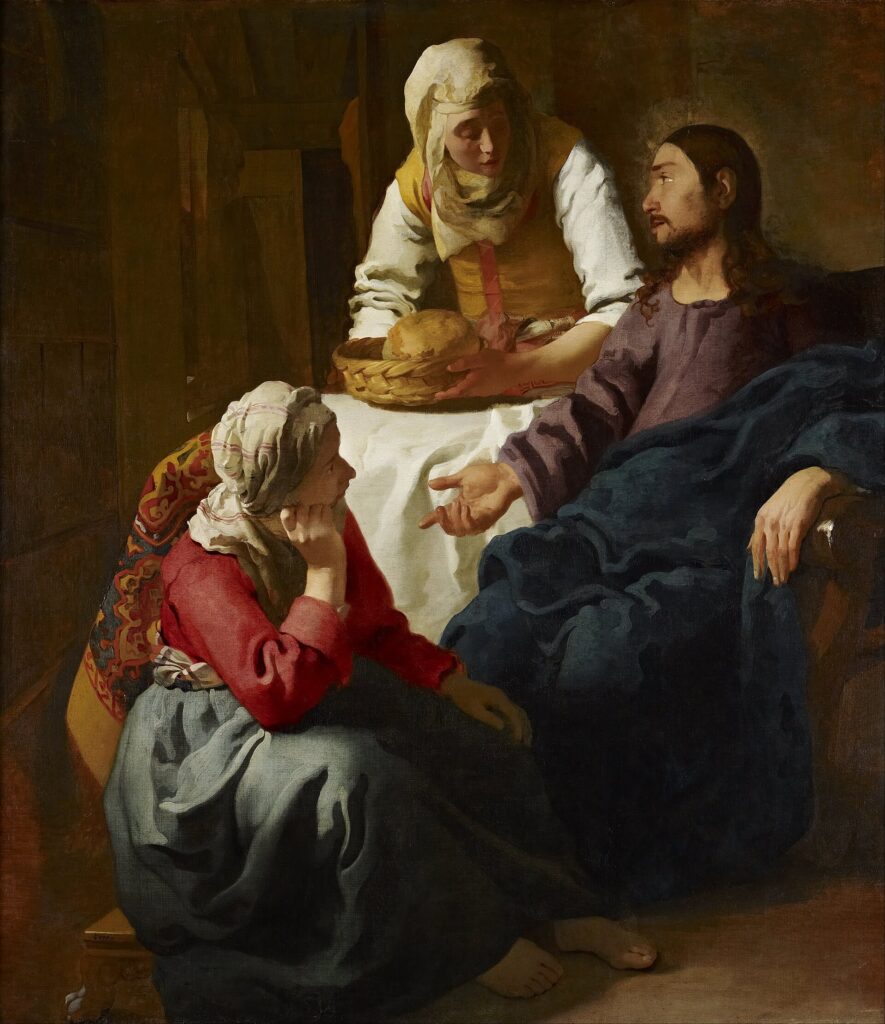
Martha is likely embarrassed by her sister’s bold behavior, and seemingly frustrated that she has been left to handle all of the preparations for Jesus’ visit by herself. When she complains to Jesus that Mary isn’t helping her, Jesus responds, “…you are worried and upset about many things, but few things are needed—or indeed only one. Mary has chosen what is better, and it will not be taken away from her.” Luke 10:41-42 (NIV)
Jesus not only defends Mary’s culturally inappropriate behavior, but He praises it, pointing out that Mary has made the better choice. In the midst of an oppressive culture that, in essence, taught that a woman’s place was in the kitchen serving men, Jesus spoke out against this idea to clarify that a woman’s rightful place was at His side learning from Him as a disciple. This was a revolutionary suggestion at that time.
Blessed because of motherhood?
Continuing along the same lines of Jesus’ revolutionary paradigm of a woman’s worth leads us to Luke 11:27, which says, “While he was saying these things, some woman lifted her voice above the murmur of the crowd: “Blessed the womb that carried you, and the breasts at which you nursed!” (MSG)
To set the stage, Jesus is teaching a crowd when this woman, presumably blessed by what He is saying, apparently seeks to express her appreciation by proclaiming this blessing over Jesus and His mother. This blessing she proclaims is part of the traditional rabbinic blessing. In Jewish culture, a woman’s value came primarily through giving birth to a male child. Jewish culture taught that a woman was blessed indirectly through her son or husband, who could study the Torah and attend synagogue. So this woman is pronouncing a blessing over Jesus in the only way she’s been taught is acceptable – by blessing the woman who birthed and raised Him.
I love Jesus’ response. He doesn’t correct the woman or deny that motherhood is an amazing blessing. Motherhood and fatherhood are among the most wonderful blessings this world has to offer. However, Jesus makes it clear that there is something that is even better:
Jesus commented, “Even more blessed are those who hear God’s Word and guard it with their lives!”
Luke 11:28 (MSG, emphasis mine)
Jesus makes it clear that the greatest blessing for a man or woman is to hear and keep the Word of God.
I recently had a woman write to me who was unable to have children. She was hurting because she had heard a Christian man suggest that a woman’s life doesn’t really start until she becomes a mother. Since she was unable to have children, she didn’t know how to process this and wanted to believe that there had to be more to her purpose and existence on this earth than just to be a mom.
If you are a woman who has ever battled with these same feelings, I want to encourage you that your purpose is more than just being a wife and mother. While becoming a wife and mother is a noble, rewarding, and praiseworthy pursuit, it pales in comparison to the reward and blessing of learning God’s word and living your life in obedience to it. Learning God’s word and obeying it leads to a personal relationship with the God of the universe. This relationship is mankind’s ultimate purpose, and the very reason we were created: to become God’s family. There is no greater fulfillment than to experience intimacy with God.
For men or women, our lives don’t begin when we become a wife and mother or husband and father; they begin when we decide to follow Jesus. The purpose He gives our lives and the destiny He calls us to is the only path to an abundant life full of joy. Marriage doesn’t give it to you. Kids don’t give it to you. Only a relationship with Jesus and following His plan for your life will give it to you.
The Widow’s Son
In Luke 7, we see Jesus care for a widow when He is filled with compassion for her. The woman in Luke 7:12 has just lost her only son, and she is already a widow. This would be a devastating situation for a Jewish woman to be in, not only because of the emotional suffering of losing her son and husband, but also because Jewish women were often dependent on their male family members for their livelihood. Since this woman had already lost her husband, her best hope for financial security would be her son providing for her needs. With both of her potential providers gone, she would now be in an extremely vulnerable position.
Jesus is moved with compassion at the woman’s plight as we read:
…Jesus went to a town called Nain, and his disciples and a large crowd went along with him. As he approached the town gate, a dead person was being carried out—the only son of his mother, and she was a widow. And a large crowd from the town was with her. When the Lord saw her, his heart went out to her and he said, “Don’t cry.”
Luke 7:11-15 (NIV)
Then he went up and touched the bier they were carrying him on, and the bearers stood still. He said, “Young man, I say to you, get up!” The dead man sat up and began to talk, and Jesus gave him back to his mother.
When many men in the culture in that day would have treated the woman as though she were invisible, Jesus refused to pass her by unnoticed, but instead tended to her needs in the most remarkable way. Jesus was tender and compassionate to the needs of women.
The prostitute who washed Jesus’ feet
Repeatedly in the scriptures, we see Jesus offer dignity and mercy to women whom, according to ritual law, deserved judgment. For instance, Jesus’ startling defense of the prostitute who washed His feet with her hair. The prostitute’s actions would have been considered scandalous in that day and age. We get a peek into what people were thinking in the words of the dinner’s host, a prominent religious leader named Simon. Simon says, ‘…“If this man were a prophet, he would know who is touching him and what kind of woman she is—that she is a sinner.”’ (Luke 7:39, NIV)
It was considered scandalous to even converse with a woman in public, so you can imagine the shock the present company would experience at the sight of the town harlot kissing and washing a man’s feet with her own hair… but Jesus doesn’t care.
Jesus doesn’t get embarrassed by the woman’s actions. He doesn’t shame her or correct her while she is in this vulnerable position in front of all these people. He doesn’t lose his temper at being made a spectacle at this dinner with prominent religious leadership. He doesn’t look down on the woman for the fact that she has caused some to doubt His legitimacy as a prophet. These are all the actions that would have been expected from a rabbi in this situation. No other religious man in that culture would have tolerated her presence.
Jesus takes the opportunity to challenge the status quo, not only tolerating her presence but also celebrating it. He praises her actions and defends her worth. He forgives her sins and points out that she loves much because she has been forgiven much. He publicly rewards her boldness, tells her that her faith has saved her, and tells her to go in peace.
The woman caught in the act of adultery
In John 8, we read of a woman who was publicly humiliated as she was paraded as an adulteress to be stoned before a group that Jesus was teaching. The Pharisees attempt to trap Jesus by asking Him if they should stone the woman as the law commands.
It’s worth pointing out that according to Mosaic law, the man who was fornicating with the adulteress should have also been stoned.
If a man commits adultery with another man’s wife—with the wife of his neighbor—both the adulterer and the adulteress are to be put to death.
Leviticus 20:10 (NIV)
Unlike the surrounding nations, God’s law held men to the same sexual standard as women. In Hammurabi’s Babylon, a married man could sleep with slaves, concubines, or prostitutes without committing any crime. God’s law gave no man that freedom, and when adultery was punished, both the man and the woman faced the same penalty. This equal treatment was another testament to the equality of men and women in God’s view. Yet, in Jesus’ day, suspiciously, only the woman was brought for punishment, which is flawed to begin with. What happened to the man? How did they catch the woman in the act without catching the man?
Jesus could have pointed this out and pursued the fact that this looks like an unjust setup of the woman, but Jesus chooses to skip the legal debate altogether and instead jumps to a more fundamental truth. Jesus, knowing that none of them are without sin, responds, “…’Let any one of you who is without sin be the first to throw a stone at her.’” (John 8:7, NIV)
Of course, all of her accusers leave. Afterward, Jesus tells her to leave her life of sin, but He also tells her that He doesn’t condemn her. He offers her dignity while calling her to freedom and a better life. Instead of being enraged or disgusted by the woman because of her sin, Jesus compassionately saw the woman beloved by God underneath the sin, when no one else was willing to. Jesus came to her defense and gave her a new beginning.
There are many more examples of Christ’s revolutionary treatment of women in the Bible, but I’ve endeavored to summarize Christ’s heart with this small sampling of His interactions with women. In just the few stories I’ve shared here, we see that Jesus recognized, respected, honored, praised, cared for, defended, protected, and trusted women. He treated them as equals even when doing so meant radically opposing the current culture. In doing so, Christ revealed God the Father’s heart toward His daughters.
Roles of powerful women in the Bible
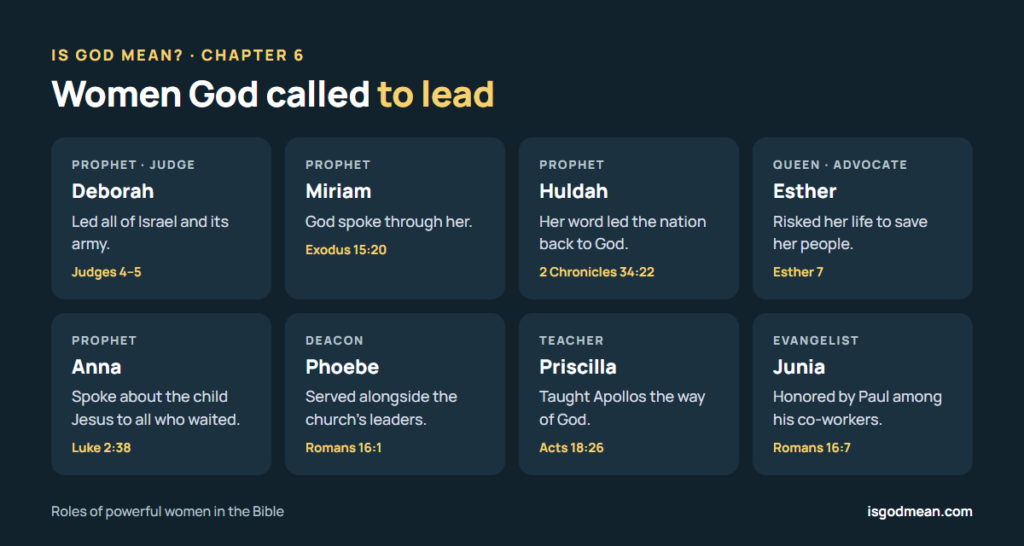
There are many examples in the Bible of God trusting women to lead, teach, and minister in a number of different ways. For instance, in the Old Testament we have the example of Deborah, who was a prophet, judge, successful military leader, and a ruler over all of Israel. She communicated God’s word to the people and carried out God’s commands. Her God-ordained position of authority showcases God’s trust in women to hold significant influential positions of leadership.
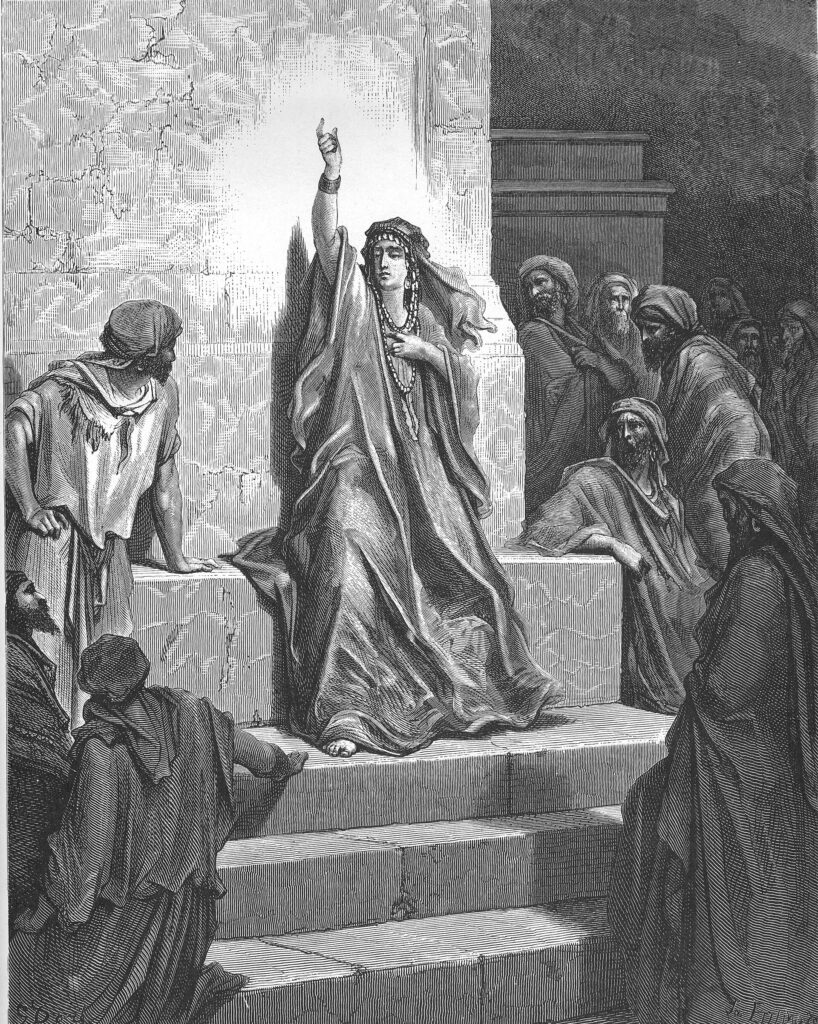
Along with Deborah, other notable women in the Old Testament given the title of prophet are Miriam, who claimed God spoke through her (Exodus 15:20, Numbers 12:2), and Huldah who spoke on God’s behalf to King Josiah of Judah (2 Kings 22:14-20; 2 Chronicles 34:22-28). Huldah’s prophecy led to a fresh start for the entire nation of Judah as they committed themselves once again to God.
In addition to the role of a prophet, the women of the Old Testament carried many other vital roles in Biblical history. Esther was not only the queen of Persia but also a courageous advocate for the Jewish people, risking her life to save theirs as she took a stand for justice (Esther 7). Moses’ mother is remembered as a resourceful rescuer who found a way to save Moses’ life despite the king’s vicious orders (Exodus 2). Rahab became a protector when she bravely hid Israelite spies (Joshua 6:17), and Jael is recognized as a strong deliverer who drove a tent peg through the head of the commander of the army oppressing God’s people.
The iconic Proverbs 31 woman, the gleaming example of idealized Biblical womanhood, is praised not only for her skill as a homemaker, wife, and mother, but also for her entrepreneurial savvy and economic ingenuity. She purchases land of her choosing, plants a vineyard with her own savings, and sells clothing she made from the finest linens, all while managing a productive household. She’s quick to assist anyone in need and uses her prosperity to help the poor. Her multifaceted capabilities, nobility, and industrious nature reward her with great admiration and praise.
This precedent of influential women is mirrored in the New Testament with figures like the prophet Anna, who spoke about Jesus when He was a child “…to all who were looking forward to the redemption of Jerusalem.” (Luke 2:38 NIV) A female deacon named Phoebe is introduced in Romans 16:1. It’s worth noting that the word used to describe Phoebe refers to a Christian designated to serve alongside the overseers and elders of the church in various ways, as described in 1 Timothy 3:8, 12.
Lydia is considered by many to have hosted the first church at Philippi as she hosted what may have been the first gathering of believers there (Acts 16:40). Priscilla, while alongside her husband, taught Apollos the ways of God (Acts 18:26). Paul praised his female coworkers in the early church like Junia, Euodia and Syntyche who were contenders for the gospel and are now commonly recognized as evangelists (Philippians 4:2-3, Romans 16:7). Mary, Joanna, and Susanna actually spent some time traveling with Jesus and His disciples and used their considerable means to help provide for the company (Luke 8:1-3). Tabitha, who was raised from the dead, is listed as a disciple well known for doing good and helping out (Acts 9:36).
Leaders, warriors, judges, prophets, deacons, teachers, providers, entrepreneurs, advocates, deliverers, evangelists, and disciples – in all these roles, the common thread is the Bible’s recognition of women as capable, powerful, and essential to the work of God. Their contributions are celebrated for their overall impact on God’s plan and their communities. These examples serve as a powerful reminder that God desires to use women to perform mighty exploits for His kingdom.
Men and women – equal but different
While I do believe that men and women are equal, I also believe they have different roles. We are given a great example of the equal-but-different concept in the Trinity. Jesus is part of the Godhead, yet we read that He chose to submit Himself to the Father’s will by dying on the cross. Jesus said, “Father, if you are willing, take this cup from me; yet not my will, but yours be done.” Luke 22:42 (NIV).
In this passage, we see Jesus clearly searching for another path, yet willing to submit to God’s will if there is none. Going as far as to say that He desires for the Father’s will to be done, not His own. Since we see Christ submitting Himself to God the Father’s will, does that mean that Jesus is less a part of the Godhead than the Father is? Is He less powerful? Is He less glorious? No, Jesus is equally God. He is omnipotent and omniscient, yet He operates in a different role while in complete unity with God the Father and the Holy Spirit.
Yet, as Christ humbled Himself, we read that the Father exalted Him to the highest place. Speaking of Christ, the scriptures say:
Who, being in very nature God, did not consider equality with God something to be used to his own advantage; rather, he made himself nothing by taking the very nature of a servant, being made in human likeness. And being found in appearance as a man, he humbled himself by becoming obedient to death— even death on a cross! Therefore God exalted him to the highest place and gave him the name that is above every name, that at the name of Jesus every knee should bow, in heaven and on earth and under the earth, and every tongue acknowledge that Jesus Christ is Lord, to the glory of God the Father.
Philippians 2:6-11 (NIV)
I believe this kind of relationship that is represented in the Trinity should be the goal for marriage and families. I do believe God has ordained different roles for wives and husbands in marriage, just as God the Father, Jesus the Christ, and the Holy Spirit have different roles in the Godhead. While there are different roles, none are inferior to each other. Likewise, while there are different roles in a marriage, neither is inferior to the other.
The S Word
We’ve got to talk about the dreaded S word – submission. This word has vexed many women and has been abused by many men over the centuries. What does the Bible have to say about submission? Sadly, in many religious circles, an almost oppressive patriarchal tone has been the standard for hundreds, even thousands, of years. As noted by Jesus’ anti-cultural actions, I truly believe this grieves the Father’s heart. God hates the oppression of His people and longs to see all of His children treated with dignity, respect, and honor.
That being said, there’s no denying that the scriptures do have a lot to say about submission. So let’s look a little more closely at what the Bible actually teaches on the topic.
First of all, it’s important to note that in Ephesians 5 all believers are instructed to submit to one another.
Submit to one another out of reverence for Christ.
Ephesians 5:21 (NIV)
This scripture would, of course, apply to husbands and wives. I believe the verses immediately following verse 21 highlight exactly how wives are supposed to submit to their husbands, and how husbands are supposed to submit to their wives. Let’s look at God’s plan for submission for both the husband and the wife:
Paul gives instruction to the wives first:
Wives, submit yourselves to your own husbands as you do to the Lord. For the husband is the head of the wife as Christ is the head of the church, his body, of which he is the Savior. Now as the church submits to Christ, so also wives should submit to their husbands in everything.
Ephesians 5:22-24 (NIV)
I do believe this scripture makes it clear that God has ordained man to operate in the role of head of the marriage, but, again, this should never be confused with the false belief that the wife, or her needs and desires, should take a back seat to the man’s needs and desires. We’ll see in a moment that the man is actually supposed to give his wife’s needs priority over his own. Again, the wife is not to be considered inferior to the man any more than Christ submitting to God made him an inferior or less valuable member of the Godhead. I believe the reason men are given the role as head of the marriage is highlighted in the amplified version of verse 24:
But as the church is subject to Christ, so also wives should be subject to their husbands in everything [respecting both their position as protector and their responsibility to God as head of the house].
Ephesians 5:24 (AMP)
I believe the man is to be considered the head of the marriage simply because he is the one who will be held responsible for protecting and leading his family in the ways of God.
At my job, I oversee multiple teams and departments. If a member of one of the departments drops the ball, the person I address and hold responsible for the error is the department head and team leader. As the head of the department, they will ultimately have to answer for the error. Due to this, I have also granted them authority to make executive decisions to lead their departments.
This is not a perfect analogy because, in my workplace example, the team lead is not an equal partner with those on his or her team. A husband and wife are equal partners. However, I use this example simply to illustrate the issue of responsibility. I could not fairly judge a team leader at my job if they had no authority to make decisions or lead their team. Likewise, a man cannot be held responsible for leading his family if he is not given the ability to do so. It would be unjust for God to hold the husband responsible if He didn’t also entrust leadership to the husband. A woman is obviously capable of leading, but the man is still the one who will be held responsible for his leadership, or lack thereof, for his family.
Now let’s look at how a man is to submit to his wife, as this ties everything we’ve talked about concerning submission together. Paul’s instruction to husbands is twice as long:
Husbands, love your wives [seek the highest good for her and surround her with a caring, unselfish love], just as Christ also loved the church and gave Himself up for her, so that He might sanctify the church, having cleansed her by the washing of water with the word [of God], so that [in turn] He might present the church to Himself in glorious splendor, without spot or wrinkle or any such thing; but that she would be holy [set apart for God] and blameless. Even so husbands should and are morally obligated to love their own wives as [being in a sense] their own bodies. He who loves his own wife loves himself. For no one ever hated his own body, but [instead] he nourishes and protects and cherishes it, just as Christ does the church, because we are members (parts) of His body. For this reason a man shall leave his father and his mother and shall be joined [and be faithfully devoted] to his wife, and the two shall become one flesh. This mystery [of two becoming one] is great; but I am speaking with reference to [the relationship of] Christ and the church. However, each man among you [without exception] is to love his wife as his very own self [with behavior worthy of respect and esteem, always seeking the best for her with an attitude of lovingkindness], and the wife [must see to it] that she respects and delights in her husband [that she notices him and prefers him and treats him with loving concern, treasuring him, honoring him, and holding him dear].
Ephesians 5:25-33 (AMP)
Just as God exalted His Son above every other name, this verse makes it clear that the man should seek to exalt his wife’s needs above every other desire, including his own needs and desires. He submits to his wife by laying down his will to place her interests ahead of his own. His wants must take a backseat to her needs.
So the Biblical idea of submission is not a man’s chauvinistic oppression of his wife’s desires in favor of his own. In fact, a man guilty of this is in direct violation of God’s instruction of mutual submission to one another. If a man willingly lays down his entire life to pursue the highest good for his wife, as God desires, then it would be natural for a woman to submit to his leadership. He is, after all, pursuing what is in her interest and using all of his strength and ability to seek the highest good for her. This is what Biblical submission looks like.
It’s also worth noting that verses 22 through 33 are specifically speaking to husbands and wives, not men and women in general. Some men believe that all women should be submissive to all men. I do not see scriptural support for this, other than God’s command that we should all humbly submit to one another, but this applies equally to men and women, not just women.
Does God endorse the rampant polygamy in the Bible?
I’d like you to keep three things in mind while exploring this question:
- The Bible never, at any point, endorses polygamy in the Bible. Critics only say that the Bible endorses polygamy because they believe that it doesn’t outright condemn it when recording the actions of sinful people in the Bible.
- I believe that the scriptures do directly condemn polygamy in the Bible, and I’ll show you where in just a moment.
- The Bible lays out a clear plan for marriage, and every time God’s will for marriage is expressed, it is always between one man and one woman.
God’s plan for marriage
In order to determine God’s ultimate plan for marriage, let’s start by looking at His original plan for marriage. In Genesis 2, we find the first union of man and woman as husband and wife. Immediately after Eve is introduced to Adam, we are given this verse:
This explains why a man leaves his father and mother and is joined to his wife, and the two are united into one.
Genesis 2:24 (NLT)
Clearly, Adam and Eve demonstrate God’s divine intention for marriage. Before there was sin and corruption in the world, when everything was pure and holy, including marriage, we are given this image of Adam and Eve becoming one flesh. Notice that verse 24 specifically says that the “two” are united as one.
It doesn’t say that three, four, or five are united as one; it specifically says that two are united as one. Some English translations simply say that “they” are united as one, but in the original language, both nouns (man and wife) in Genesis 2:24 are singular. That is why the Septuagint, Aramaic translations, and many other translations emphasize that specifically “two” become one – one husband and one wife as indicated by the original source text.
In the New Testament, Jesus repeats this idea while sharing God’s heart and plan for marriage. Let’s take a look at a conversation between Jesus and the Pharisees concerning marriage:
Some Pharisees came to him to test him. They asked, “Is it lawful for a man to divorce his wife for any and every reason?”
Matthew 19:3-6 (NIV)
“Haven’t you read,” he replied, “that at the beginning the Creator ‘made them male and female,’ and said, ‘For this reason a man will leave his father and mother and be united to his wife, and the two will become one flesh’? So they are no longer two, but one flesh. Therefore what God has joined together, let no one separate.”
Notice Jesus clearly emphasizes that it is two people, one man and one woman, that are to become one in marriage. Not many people, only two. This reflects and reaffirms that God’s plan for marriage has not shifted over the years, but remains a union between two people.
For the next portion of this chapter, I’d like to look at some controversial topics that some argue the Bible supports. Let’s start with polygamy.
Do scriptures directly condemn polygamy?
Leviticus 18 is a chapter about unlawful sexual relations. About halfway through the chapter, we get this verse:
Nor shall you take a woman as a rival to her sister, to uncover her nakedness while the other is alive.
Leviticus 18:18 (NKJV)
On the surface, this translation of the scripture sounds like it is specifically condemning having sexual relations with sisters while they are both alive. However, it is important to recognize that the phrase “a woman in addition to her sister” that is used in this verse is actually an idiomatic phrase that is used repeatedly throughout the Bible to mean “One [feminine] in addition to another [feminine].”
You can find examples of this idiomatic phrase used in this way in Exod. 26:3, 5, 6, 17; Eze. 1:9, 23; 3:13. Likewise, you can find the masculine counterpart is also used to express the same thing in Gen 37:19; 42:21, 28; Exod 16:15; 25:20; 37:9; Num 14:4; 2 Kings 7:6; Jer 13:14; 25:26; Eze 24:23; 33:20.
Many ancient Jewish scholars agreed that the use of the idiomatic phrase in this scripture should be interpreted to mean that a man should not have sexual relations with one woman in addition to another while both are alive. If you choose to interpret this verse in the same way that many ancient Jewish scholars agreed it should be interpreted, then this would obviously directly condemn the practice of polygamy.
Some argue that this verse is included in a portion of scripture directly addressing incestual relationships. This is true for all of the verses that come directly before verse 18. However, all of the verses immediately following verse 18 discuss general sexual morality. Thus, verse 18 is the dividing point in the chapter, marking the transition from discussing incestual relationships to general sexual and marital prohibitions. Thus, the established idiomatic usage of the verse is deemed applicable by many scholars. I won’t tell you what you should believe, but this provides a great starting point for you to study the topic on your own.
God’s leaders are instructed to be one-woman men
In the New Testament, we have an even more direct verse highlighting God’s opinion towards polygamy:
A bishop then must be blameless, the husband of one wife, vigilant, sober, of good behaviour, given to hospitality, apt to teach;
1 Timothy 3:2 (KJV)
While this verse speaks directly to someone desiring to be in a leadership position in the church, the idea is that anyone desiring to lead or supervise in the church must live in a way that is pleasing to God. Listed in the attributes of a life that is pleasing to God is this command that he must be a one-woman man – often translated into English as “the husband of one wife.”
I believe this verse clearly highlights God’s disapproval towards polygamy yet again, as God makes it unmistakably clear that anyone who wants to be used by God to lead His people is not allowed to be a polygamist. If God approved polygamy, why would this be a command for anyone desiring to lead in the church?
Some critics point to Deuteronomy 21:15-17 (“If a man has two wives…”) and Exodus 21:10 as proof that God’s law permitted polygamy. But like divorce, which Jesus said Moses permitted “because your hearts were hard… But it was not this way from the beginning” (Matthew 19:8), these laws regulated a situation sinful people had already created, in order to protect the vulnerable wife and her children. Regulating something isn’t endorsing it.
So in summary, one, God never endorses polygamy anywhere in the scriptures. Two, God and Jesus both emphasized that God’s intention for marriage was to be between one man and one woman. Three, there are multiple scriptures that I believe directly instruct against it. Four, anytime a story of polygamy is recorded, it is always fraught with drama, compromise, and pain. I believe this is no coincidence, but a warning of the consequences of choosing to live outside of God’s intended design.
Marry your rapist?
Some critics accuse the Bible of commanding a woman to marry her rapist. They use this scripture to back up their claims:
If a man find a damsel that is a virgin, which is not betrothed, and lay hold on her, and lie with her, and they be found; Then the man that lay with her shall give unto the damsel’s father fifty shekels of silver, and she shall be his wife; because he hath humbled her, he may not put her away all his days.
Deuteronomy 22:28-29 (KJV)
Before we address whether or not a girl was required to marry her rapist (spoiler alert – I don’t believe she was), let’s first determine why God gave His people this instruction to begin with. If the punishment for raping an engaged or married woman was death, why is the punishment not death for a woman who is not betrothed?
Before sharing my viewpoint, it’s worth noting here that there is an entire argument that verse 28 is not referring to rape, because the same word used to imply rape earlier in this chapter – ḥāzaq – is not the word used in verse 28. The punishment for the crime of ḥāzaq was death. The word used in verse 28 is tāp̄aś. There are many examples in the scriptures of this word being used in ways that didn’t mean literal physical man-handling.
People who argue this interpretation believe the scripture is alluding to the man seizing the woman’s attention and captivating her mind and seducing her into consensual sex. If that is the case, then the punishment is not the same for this situation because the crime is not rape, but consensual fornication, which would make the punishment seem very fitting. While there may be some validity to that interpretation, I’m going to place that argument aside and approach this topic from the assumption that this scripture is actually referring to rape.
If this scripture is referring to rape, why would God want a woman to marry her rapist? That seems like punishment for the woman. What we have to remember is that in their culture, a non-virgin was not considered marriage material, and she would likely struggle to find a man who would take her as his wife if she was no longer a virgin. It’s also important to remember that the majority of women were dependent on men to provide food and shelter for them. So, by requiring the man to take responsibility for his actions, God ensured that the woman would be permanently provided with food and shelter.
In their culture, men could divorce a woman at any time for any reason. This was not God’s desire or intention for marriage, but was simply the result of sin and the hardness of men’s hearts. However, in this situation, the man could not divorce the woman, but was forced to provide for the woman permanently as a result of his sin towards her.
What if the woman didn’t want to marry the man? What if the trauma was just too great and she’d rather take her chances finding provision some other way, despite the odds against her? Well, we have to remember that Deut. 22:28 isn’t the only passage we have that gives instruction on this topic. Let’s look at a parallel passage:
If a man seduces a virgin who is not engaged, and lies with her, he must pay a dowry for her to be his wife. If her father absolutely refuses to give her to him, he shall pay money equal to the dowry for virgins.
Exodus 22:16-17 (NASB)
In this scripture, we are shown that a father, if he believed a marriage was not in his daughter’s best interest, could refuse to allow the marriage to occur. We also have precedent that it was customary for the father to ask his daughter if she wanted to marry the man. Let’s look at an example:
They said, “We’ll call the girl; we’ll ask her.” They called Rebekah and asked her, “Do you want to go with this man?” She said, “I’m ready to go.”
Genesis 24:57-58 (MSG)
Genesis 24 is the story of finding a bride for Isaac. In this verse, we see that Rebekah was given the choice to go marry Isaac or to remain at home with her family. The point I want to make is that the woman was not forced to marry a man asking for her hand.
With all of this in mind, it seems there is evidence to assume that the choice to force a man to marry the woman he raped, while providing for her, was there as an option for the woman’s benefit, should she choose to exercise that right. However, the option to have the rapist pay a dowry to help her financially was also on the table.
Even in this command that seems strange to our modern worldviews, the whole point was to protect and provide for the woman. Today, this would be comparable to forcing a man who raped a woman to permanently financially support her for the rest of his life and leave his estate to her when he passes. If we practiced this today, rather than the weak punishments our government often enforces, I’m sure we’d have much less of this crime, and women who are much better supported.
Did Paul forbid women to teach in church?
It is difficult to address the topic of misogyny in the Bible without addressing this passage:
I also want the women to dress modestly, with decency and propriety, adorning themselves, not with elaborate hairstyles or gold or pearls or expensive clothes, but with good deeds, appropriate for women who profess to worship God.
1 Timothy 2:9-15 (NIV)
A woman should learn in quietness and full submission. I do not permit a woman to teach or to assume authority over a man; she must be quiet. For Adam was formed first, then Eve. And Adam was not the one deceived; it was the woman who was deceived and became a sinner. But women will be saved through childbearing—if they continue in faith, love and holiness with propriety.
There is tons of information out there about this passage. Many different paradigms, translations, and ideas about the proper application of these verses have been published and argued about for centuries. I in no way approach this topic as if I have the final word. I simply want to share my current understanding of the purpose of these passages, which is always subject to change as I continue to seek the Holy Spirit for understanding while wrestling with difficult passages such as these.
I encourage you to prayerfully seek God for yourself regarding the proper interpretation and application of these passages, but if sharing my understanding could help someone launch a more productive investigation of their own, then I am happy to share my thoughts.
A universal prohibition?
Let’s begin our study of this topic by looking closely at 1 Timothy 2:12:
I do not permit a woman to teach or to assume authority over a man; she must be quiet.
1 Timothy 2:12 (NIV)
Since we know that God specifically ordained some women, like Deborah, to rule with authority over men, this scripture seems confusing, or even contradictory, to what we’ve read elsewhere in the holy scriptures. Also, as we’ve already looked at, even Paul himself praises women serving in the clergy. So if Paul, and even more importantly God, had no intrinsic problem with the general idea of a woman holding positions of authority, then what is this scripture trying to say?
I believe it is important to note that there are scholars who teach that the Greek verb ‘epitrepo’ (“I allow, permit”) that is used in the first part of verse twelve is not intended as a universal prohibition. When that word is used in the Septuagint (the Greek translation of the Old Testament), it is used to address specific and limited situations. It is not used to address universal situations. It was in the present tense: “I am not allowing.” He was describing what he was doing, not giving a directive or command for all people for all time. Therefore, it makes sense that Paul’s instructions here were specifically for that audience and their specific situation.
I’m not saying that the message doesn’t still hold value for us today. It does; otherwise it wouldn’t be included in our Holy Bible. However, many have attempted to turn that passage into a tool to force all women to be subservient to all men all the time. I don’t believe that is how this passage should be understood. So what was Paul attempting to communicate to Timothy in this passage?
Protecting against corruption from the cult of Artemis
To understand what Paul is trying to communicate, you need to be aware of the historical context in which the Church of Ephesus was birthed. Dr. Gary Hoag, in his monograph Wealth in Ancient Ephesus and the First Letter to Timothy: Fresh Insights from Ephesiaca by Xenophon of Ephesus (Eisenbrauns, 2015), paints an eye-opening picture of life in Ephesus.
At the time of Paul’s letter, the temple of Artemis, one of the seven wonders of the ancient world, was the religious center of the whole region, and it hosted the worship of the mythological goddess. Artemis was considered by her worshipers to be the mother of all life, the one who nourished all creatures, and was considered the power of fertility in nature. She was also considered the goddess of childbirth. In a time when mortality rates in childbirth were devastatingly high, young mothers-to-be looked to her to keep them safe in childbearing.
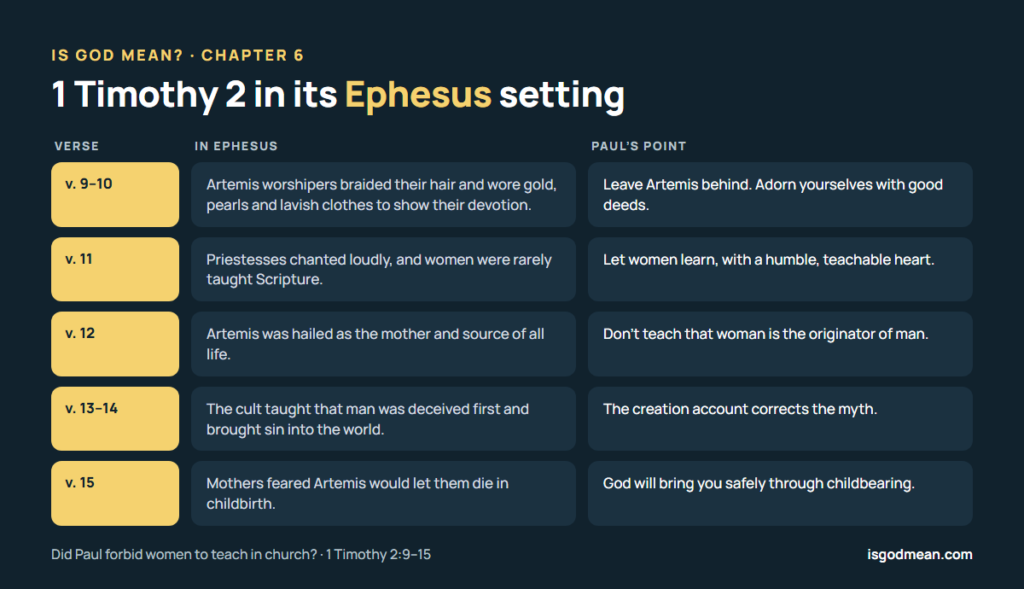
The cult of Artemis was led largely by female officials and eunuch priests, and was by far the dominating religion in Ephesus. Images of Artemis covered the land. People would travel from far and wide to see her wondrous temple and wonder of the world. When travelers would visit the temple, they would find the female Artemisian priestesses loudly chanting incantations and prayers. Richard and Catherine Kroeger argue that, along with the idea that Artemis was the source of all life, these incantations taught listeners that men had been deceived during the story of creation and that it was men who had ushered sin into the world.
Ancient literary works, such as the Greek novel Ephesiaca (which Gary Hoag dates to around the same time as 1 Timothy), paint a vivid picture of life in Ephesus during Timothy’s day. Ephesiaca was an ancient Greek novel about two young people (Anthia and Habrocomes) who fall in love. The story, set in Ephesus, tells of their meeting, marriage, tragic separation, and their later reunion.
Both of the main characters are devoted worshipers of Artemis, and Anthia serves in the temple. This story gives us an insider’s look into the cult of Artemis and the function of the Artemisium for the Ephesians. One of the key insights the novel reveals is that wealthy women would wear amulets, lavish garments, and gold and pearls, and braid their hair like Artemis to show their piety to the false goddess.
The worship of Artemis affected the way they dressed, the way they thought, the way they worshiped, how they formed their social structures, and it even drove their economy. All of life in Ephesus seemingly revolved around the temple of Artemis. We see this reflected in Scripture in Acts 19:23-41, where, after seeing silver shrines to Artemis, a riot is triggered by Paul’s teaching that a god crafted by human hands is no god at all.
What Paul wanted Timothy to know about Artemis
Now that we have an understanding of the historical context in which the Christian church of Ephesus was birthed, let’s break down this complex passage of Scripture verse by verse to better understand what I believe Paul was attempting to communicate to the young pastor of the new church at Ephesus:
I also want the women to dress modestly, with decency and propriety, adorning themselves, not with elaborate hairstyles or gold or pearls or expensive clothes, but with good deeds, appropriate for women who profess to worship God.
1 Timothy 2:9-10 (NIV)
The term πλέγμασιν, translated above as “elaborate hairstyles,” is a rare term and is one of the words found in Ephesiaca when referring specifically to the hairstyle of wealthy Ephesian women who served Artemis in the temple as they imitated her hair and clothing. In the past, some scholars have taught that these women were being instructed not to dress like prostitutes or the new Roman women. However, the new evidence provided by Xenophon’s Ephesiaca (which Gary Hoag has recently placed in the time period of Paul and Timothy) seems to suggest that they were instead being instructed to no longer dress as they would have done to serve Artemis. They were to leave this behind upon conversion.
Since Paul seemed to be specifically addressing the issue of dressing like they did to perform cultic activities, it only seems fitting that the ἱματισμῷ πολυτελεῖ, (translated above as “expensive clothes”) included in the same sentence was also addressing the same issue – which, again in Ephesiaca, we find these cultic activities led by prominent and wealthy women, and they were expected to perform good deeds out of εὐσεβεία, “piety,” to Artemis.
In this verse, I believe Paul was simply combating the mixed devotion to Jesus and Artemis that the new converts of the Ephesian church were likely struggling with. He did not want the new Christian converts to appear like pagan religious leaders. Paul wanted these new converts to abandon Artemis altogether, including in the way they dressed, and instead focus on living in a way that honors God through good deeds.
A woman should learn in quietness and full submission.
1 Timothy 2:11 (NIV)
First of all, the fact that Paul was encouraging women to learn the Scriptures was an enlightened position, as this was not the norm in Jewish tradition during Paul’s day. So, this instruction was already countercultural for that time period and favored equality for women.
Next, it’s important to note that in Jewish culture (Paul’s culture), everyone, including men, was required to learn in silence, not just the women. New learners, who were traditionally only male, were expected to learn in silence until they reached maturity. The phrase “silence and submission” was a Near Eastern formula that simply instructed the learner to be willing to apply the lessons they learned – to be doers of the Word and not hearers only. So I believe this scripture was simply instructing the women, along with the men, to be receptive and teachable, willing to apply instruction to their lives.
Keep in mind that the female worshipers of Artemis were used to running the show, and they did not learn in quietness or submission; instead, they loudly recited incantations and prayers at their temple, and they were certainly not used to taking instructions from a man during worship. Being willing to alter their mindsets to humbly receive instruction, even if their teacher was a man, would be a critical adjustment to living a successful Christian life.
It’s also important to consider that many of the new female converts were likely being mentored by older women already established in the Christian faith, so the “full submission” may not have even been submission to a man, but merely to their teacher. I believe this passage is not so much about gender as it is simply about having a humble and teachable heart.
I believe Paul wanted to ensure that an orderly educational setting was maintained, and that the church didn’t turn into an argumentative philosophical debate with new converts just leaving a pagan religion. It was important that the new converts take time to humbly learn the ways of God before attempting to usurp the authority of the pastor/teacher in order to prevent corruption from infiltrating the new church at Ephesus.
Can a woman have authority over a man?
I do not permit a woman to teach or to assume authority over a man; she must be quiet.
1 Timothy 2:12 (NIV)
To properly understand this verse, it is important to take a closer look at the Greek word translated as “authority” in our English Bible. This is the only time in the New Testament that the Greek word “authenteō” is used to denote authority. This has led to many different thoughts on how to properly translate the word.
Some scholars have recognized this word to represent inappropriate authority. You could simply see this verse as Paul instructing women not to take inappropriate authority over men, and I think most of us would view this as a totally acceptable and healthy instruction. However, I believe the truth is actually much more profound than that.
I’m going to provide a very brief summary of the interpretation of this passage as presented by Dr. Catherine Clark Kroeger (with Richard Clark Kroeger) in her 250-page book I Suffer Not a Woman: Rethinking 1 Timothy 2:11-15 in Light of Ancient Evidence (Baker, 1992). It may seem a bit complex as I work through it, but I will simply paint the conclusion of why it matters at the end.
1 Timothy 2:12 uses the Greek word “didaskein” for the verb “to teach”. This is the verb that the woman is being prohibited from – “I suffer not a woman to teach”. The problem is that this verb has often been connected by interpreters to the noun “a man” later in the verse for the interpretation “to teach a man.” However, this interpretation does not hold up grammatically.
For “a man” to be brought forward to connect with “to teach” in this way, the Greek word would need to be spelled ‘andra’. However, it is actually spelled ‘andros’ here, indicating it is not intended to connect with “to teach”, so the interpretation “to teach a man” does not seem grammatically accurate. So what is the correct translation?
“Didaskein” (to teach) forms a doublet with another verb every other time it is used in the letter of 1 Timothy. Since the grammar does not allow it to connect with “a man,” it appears it should connect with the word ‘authentein’ instead. If that’s the case, how should ‘authentein’ be interpreted?
Many English translations translate this word to mean “to exercise authority over,” but it should be noted that while New Testament authors often write about ruling and exercising authority, they never use the word ‘authentein’ while doing so. Rather, they use ‘kurieuein’ or ‘exousiazein’.
The word ‘authentein’ was used with what appears to be a wide range of meanings, and by the New Testament era, ‘authentes’ was being used to denote an “originator” or “instigator” (this sense is also reflected in the word’s adjective form ‘authentikos’ which, like the English adjective “authentic”, has the sense of “original” or “genuine”).
In the late Renaissance, another definition of the verb form ‘authentein’ was included in Greek dictionaries: “to represent oneself as the author, originator, or source of anything” (this definition relates specifically to situations where the verb “authentein” is used with an accompanying word in the genitive case, as it was in 1 Tim 2:12).
Putting it all together
So what does all this mean? Once you properly connect the verb “Didaskein” to the verb “authentein,” you get a translation that would be something like, “I do not permit a woman to teach nor to represent herself as the originator of man.” For those of us who understand that the Artemis cult was actively promoting the myth that Artemis was the mother of all life, it makes perfect sense why Paul would be instructing against allowing this teaching in the church.
The last part of verse 12, often interpreted as instructing a woman to be “quiet,” uses the Greek word ‘hesuchios’. The adjective form of this word was used just a few verses earlier in verse 2 and refers not to instructing someone to be quiet, but rather to leading a quiet life in harmony with your neighbors, free from hostility and strife. Something that would be very important if heretical teaching from the cult of Artemis was threatening to disrupt the harmony of the Ephesian church.
Let’s keep moving through the passage:
For Adam was formed first, then Eve. And Adam was not the one deceived; it was the woman who was deceived and became a sinner.
1 Timothy 2:13-14 (NIV)
Again, the cult of Artemis promoted the idea that woman was the author of man, and that man was the one who was deceived first and ushered sin into the world. This verse appears to be clearly directed at correcting this pagan myth. I believe Paul was simply attempting to protect the congregation against a very popular heretical teaching that dominated that region.
Let’s now look at the final scripture in this passage:
But women will be saved through childbearing—if they continue in faith, love and holiness with propriety.
1 Timothy 2:15 (NIV)
This scripture has confused many people because it doesn’t make much sense without context. We know that salvation only comes through Jesus, and we’ve all learned that we are saved by grace through faith. So what is this message that women are saved through childbearing?
An easier-to-understand translation would be “women will be brought safely through childbearing.” Remember that in Greek mythology, Artemis helped her mother deliver her twin brother Apollo. Because of this, she became known as the goddess of childbearing, and women in labor looked to her to keep them safe during childbirth. The cult of Artemis taught that the consequence of not remaining faithful to the goddess was death in childbirth, and since mortality rates during childbirth were so high at that time, there was immense pressure and fear on women to remain faithful to Artemis.
This verse is simply reassuring women that they will be brought safely through childbearing as they choose to follow the one true God.
God’s beautiful message to women
When you understand this passage of scripture in its proper context, it totally transforms its meaning from an oppressive message into a beautifully freeing one. Far from wanting to limit the voice and influence of women, Paul was simply seeking to protect the church from the corruptive teachings of the cult of Artemis while also offering hope and freedom to new converts in their newfound way of life.
The new followers of Yeshua don’t have to live in fear of a vengeful goddess who threatens to murder them while they are in labor. These women can now rest assured that God will bring them safely through childbearing. A promise that is still comforting even today! God’s ways bring liberty and life, and even in this difficult passage, His love for His daughters shines through when you understand it for what it truly is.
Why did Paul command women to stay silent in church?
There’s another passage that some believe to be a parallel passage that says:
Women should remain silent in the churches. They are not allowed to speak, but must be in submission, as the law says. If they want to inquire about something, they should ask their own husbands at home; for it is disgraceful for a woman to speak in the church.
1 Corinthians 14:34-35 (NIV)
Scholars far more qualified than me have debated the correct application of this verse for centuries. Some have concluded that women should remain silent in church, and others have reached the conclusion I’m going to share below. Just like with all difficult passages, I’m not going to tell you what you should believe, but I will share information with you that helped me form my beliefs. I would encourage you to prayerfully review the following information with an open mind and invite the Holy Spirit to guide you into all truth.
Sons and daughters will prophesy
First of all, it’s important to note that just a few chapters earlier, in 1 Corinthians 11, while writing to the same audience, Paul provided instructions on how women were to pray and prophesy in church. This leaves one wondering: how can a woman stay silent in church and pray and prophesy at the same time? What are we missing?
Throughout this study, we have reviewed numerous examples of female ministers and prophets in the Bible. Let’s look at one more. In Acts 2:17, we again see the idea of female prophets endorsed by God:
‘In the last days, God says, I will pour out my Spirit on all people. Your sons and daughters will prophesy, your young men will see visions, your old men will dream dreams. Even on my servants, both men and women, I will pour out my Spirit in those days, and they will prophesy.’
Acts 2:17-18 (NIV)
This scripture goes out of its way to highlight that in the last days both men and women will prophesy as the Spirit of God comes upon them. With so many biblical examples of women being chosen and called by God to minister to others, what are we supposed to do with this scripture commanding women to be silent? As with most challenging portions of scripture, I believe that looking into the historical context and the original language in which this passage was written will bring a lot of clarity to the subject.
“Speak” versus “talk”
There are many often-argued ideas of why Paul wrote this passage in his letter. Just like in Ephesus, Artemis worship was the cultural norm in Corinth. Let’s keep in mind that the people of Corinth would have been accustomed to women-led services full of loud chanting and incantations. Their reference point for worship revolved around women dominating the flow, order, and content of their worship rituals. With that in mind, it is possible to see how a scenario in which the women interrupted, debated, or questioned the speaker in the middle of the service could occur.
In addition to that, many people believe that the word “speak” in the verse would be better understood and interpreted as “talk”. The word “talk” carries a disruptive connotation in this context. Even today we’d say that congregants shouldn’t “talk” in church because it is distracting and disrespectful. That, of course, doesn’t mean that we think congregants should be barred from ministering in church. The vast majority of us welcome the idea of congregants testifying, praying, singing, and prophesying when the Spirit of the Lord is directing them to do so in an orderly fashion.
Saying women shouldn’t talk during service definitely carries a different sentiment than saying women shouldn’t speak in church. The idea behind this view is that if women were discussing the sermon amongst themselves, or interrupting, questioning, and debating the speaker, they were making it hard for others to hear the sermon, and they should instead wait until the service is over to discuss it privately.
The culture of the Corinthian church
Kenneth E. Bailey provides an illuminating look into what the Corinthian church was likely experiencing in his book Paul Through Mediterranean Eyes: Cultural Studies in 1 Corinthians. Kenneth points out that the Corinthian church was very diverse, including those who were fluent in Greek and others who knew just enough to get by. There were likely non-native Greek speakers with very strong accents, making it difficult to understand, leading people to ask those around them to explain what was being said.
Add to this that in a predominantly oral culture, it would have been normal for the audience to begin discussing the subject amongst themselves as soon as a speaker paused. This was their way of learning and retaining information. It is also believed by many that men and women sat separately in the church. This could have led women to shout questions to their husbands across the aisle. Or, as it was culturally normal for women to chat amongst themselves if they were not being directly addressed, it is possible that the women were loudly chatting, making it difficult for the rest of the congregation to hear the speaker.
With this view, Paul was simply offering instruction to address that particular problem at that particular church, and it was not intended as a universal command for all women, for all time. Rather, the takeaway for us today is simply to respect one another by remaining quiet when others are addressing the congregation, so that everyone can listen and learn.
It was not, however, suggesting women should not be allowed to minister in church. This seems especially obvious considering that just a few verses earlier, literally a few sentences apart, Paul acknowledged that both men and women have something to share, and that it should be shared in a way that edifies the congregation:
What then shall we say, brothers and sisters? When you come together, each of you has a hymn, or a word of instruction, a revelation, a tongue or an interpretation. Everything must be done so that the church may be built up.
1 Corinthians 14:26 (NIV)
Notice that it says brothers and sisters have something to share, and Paul doesn’t stop there. He literally wraps up the entire chapter with the final two verses urging brothers and sisters to be eager to prophesy and speak in tongues in an orderly way in a corporate setting.
Therefore, my brothers and sisters, be eager to prophesy, and do not forbid speaking in tongues. But everything should be done in a fitting and orderly way.
1 Corinthians 14:39-40 (NIV)
So verses 34-35, which suggest women should be silent in church, are literally sandwiched in between two verses encouraging the vocal participation of women during church service. This, along with the wealth of evidence endorsing female ministry that we’ve reviewed throughout this study, makes it clear that Paul was not restricting the role of female ministers in the church. He simply wanted a service where everyone attending could effectively receive and be edified without distraction.
This whole section of Paul’s letter was about establishing order in the services to subdue the chaos that had apparently become characteristic of the Corinthian church gatherings. So, this interpretation would fit within the context of the passage.
A second opinion
I think there is real merit to this view of 1 Corinthians 14:34-35 that we’ve just explored, and it very well may be the correct way to approach this difficult passage. However, with this view, I am left with four questions.
First, Paul instructs women to ask their husbands at home about the sermon, but what about single women in the congregation? Who are they supposed to ask?
Secondly, the vast majority of men in that church would have been new converts who started learning at the same time as the women. They would not have been any better suited to answer questions than their wives. So why encourage the wives to ask their equally uneducated husbands?
In Judaism, it was customary for boys to begin Torah study early while the women were sadly excluded from this learning. If Paul had sent this letter to a new Christian church in Israel, I could see the logic behind such a command, as the men would have had a head start on biblical knowledge. However, this was Corinth, and the males would not have had any head start in learning Scripture. Thus, this command seems odd and makes me think there may be more to the story.
Thirdly, why was it necessary for Paul to single out the women as strongly as he did? I understand that many of the new converts were transitioning out of the female-led Artemis worship, but it still seems that his many other instructions for maintaining order would have been sufficient without the need to specifically call out women to stop talking in church while ignoring the men. Plus, the context of this chapter suggests that the problem was with multiple people prophesying, praying, and speaking over one another at the same time. Not with mindless chit-chat distracting congregants.
Fourth, the verse immediately following 34-35 seems very odd and out of place when trying to understand it from the paradigm we’ve explored so far:
Women should remain silent in the churches. They are not allowed to speak, but must be in submission, as the law says. If they want to inquire about something, they should ask their own husbands at home; for it is disgraceful for a woman to speak in the church.
1 Corinthians 14:34-36 (NIV)
Or did the word of God originate with you? Or are you the only people it has reached?
What does verse 36 mean? Is it referring to the two verses immediately before it? If not, then why was it placed there?
In light of these four questions, I believe there is a better way to interpret this passage of Scripture. Let’s take a look at it now.
Who actually said it?
In Ancient Greek, there were no quotation marks. So determining what to put in quotes in our modern Bible was up to interpreters to discern using the structure of the original Greek text. For this reason, different translations of the Bible often vary in what they choose to put in quotes. An example of this is 1 Corinthians 6:12:
“I have the right to do anything,” you say—but not everything is beneficial. “I have the right to do anything”—but I will not be mastered by anything.
1 Corinthians 6:12 (NIV)
In the example above from the NIV translation, there are quotes around “I have the right to do anything…” You’ll also find the NCV, NLT, and NRSV translations of the Bible also use quotation marks in this verse. However, in the ASV, KJV, NASB, and NKJV there are no quotation marks. Since we know that, as followers of Christ, we are not given the right to do anything, I believe the NCV, NIV, NLT, and NRSV are accurate in including this popular Corinthian slogan that the Corinthians used to justify their immorality in quotation marks.
Doing so makes it clear that these words did not originate with Paul as part of inspired instruction, but rather identifies a damaging belief held by the Corinthians that Paul was seeking to correct. In essence, Paul was saying, “You say you have the right to do anything, but in reality we know that not everything is beneficial.”
The problem is that not all translations include quotation marks around the Corinthian slogan. Due to this, I have heard some people wrongly teach that everything is permissible for Christians, even though not everything is beneficial. They come to this conclusion because the translation they are reading looks like this:
All things are permitted for me, but not all things are of benefit. All things are permitted for me, but I will not be mastered by anything.
1 Corinthians 6:12 (NASB)
You can see how removing the quotation marks drastically changes the understanding of the scripture. Without the quotation, it does seem that Paul is suggesting that all things are permitted for Christians, but we know that ideology is just not cohesive with the rest of Scripture. We know that there are clear moral guidelines that followers of Christ are expected to follow. For instance, committing murder, stealing, and lying are clearly not acceptable behavior for a follower of Christ. No sin is considered permissible behavior.
This verse is just one of many in the book of 1 Corinthians where Bible translators have been inconsistent in how they handle quotations. I explain all of this to say that there is a view that is quickly gaining popularity, suggesting that 1 Corinthians 14:34-35 belongs in quotation marks. This view implies Paul was quoting a Corinthian slogan that held influence over his audience so that he could immediately refute it in the following verse.
If 1 Corinthians 14:34-35 was just a flawed Corinthian slogan, possibly an idea proposed by Judaizers infiltrating the Corinthian church, then the verse immediately following it was Paul’s rebuke of the idea. He asked the men who originally made the quote if the Word of God originated with them, or if they were the only ones the Word of God had reached. Obviously, the answer to those questions is no; thus, they do not have the right to limit who can speak in the church.
Hidden characters in the Greek
I believe the strongest argument for this view was Paul’s use of the “expletive of disassociation” in the original Greek text immediately following verses 34-35. While Ancient Greek didn’t use quotation marks, it did employ the use of the expletive of disassociation, denoted by the Greek word ἢ. One way Paul used this was as an emotional rebuttal to express his disapproval of existing circumstances.
The closest equivalent to this expletive in the English language would be “What?” or “Nonsense!” or “No way!” In the book Why Not Women by Loren Cunningham and David Joel Hamilton, the authors provide a list of how Paul uses this Greek symbol throughout 1 Corinthians (The following are all from the NIV)
- 1 Corinthians 1:13 “Is Christ divided? Was Paul crucified for you? ἢ (No way!) Were you baptized into the name of Paul?…”
- 1 Corinthians 6:1-2 “If any of you has a dispute with another, do you dare to take it before the ungodly for judgment instead of before the Lord’s people? ἢ (No way!) Do you not know that the saints will judge the world?…”
- 1 Corinthians 6:8-9 “Instead, you yourselves cheat and do wrong, and you do this to your brothers and sisters. ἢ (What?) Do you not know that the wicked will not inherit the kingdom of God?
- 1 Corinthians 6:15-16 “…Shall I then take the members of Christ and unite them with a prostitute? Never! ἢ (No way!) Do you not know that he who unites himself with a prostitute is one with her in body?
- 1 Corinthians 6:18-19 “…whoever sins sexually, sins against their own body. ἢ (What?) Do you not know that your body is a temple of the Holy Spirit, who is in you, whom you have received from God?…”
- 1 Corinthians 7:16 “How do you know, wife, whether you will save your husband? Or ἢ (What?) how do you know, husband, whether you will save your wife?”
- 1 Corinthians 9:5-8 “Don’t we have the right to take a believing wife along with us, as do the other apostles and the Lord’s brothers and Cephas? Or ἢ (Nonsense!) is it only I and Barnabas who lack the right to not work for a living? Who serves as a soldier at his own expense? Who plants a vineyard and does not eat its grapes? ἢ (No way!) Who tends a flock and does not drink of the milk? ἢ (Nonsense!) Doesn’t the Law say the same thing?”
- 1 Corinthians 9:9-10 “…Is it about oxen that God is concerned? ἢ (No way!) Surely he says this for us, doesn’t he?…
- 1 Corinthians 10:22 “…you cannot have a part in both the Lord’s table and the table of demons.” ἢ (No way!) Are we trying to arouse the Lord’s jealousy?…”
- 1 Corinthians 11:20-22 “So then, when you come together, it is not the Lord’s Supper you eat, for when you are eating, some of you go ahead with your own private suppers. As a result, one person remains hungry and another gets drunk. Don’t you have homes to eat and drink in? Or ἢ (What?) do you despise the church of God by humiliating those who have nothing?…”
And finally, we come to the passage that is the focus of our study:
1 Corinthians 14:35-36 “…it is disgraceful for a woman to speak in the church. ἢ (Nonsense!) Did the word of God originate with you? Or ἢ (No way!) are you the only people it has reached?
You can see from all of these examples in 1 Corinthians that Paul often employed a question-and-answer format, in which he would pose a question and then answer it using this expletive of disassociation.
It seems that in 1 Corinthians 14:36, Paul is disassociating himself from the verse immediately before it. With this view, you could paraphrase this passage to say something like, “Should a woman remain silent in church? Nonsense! Did the word of God originate with you men? No way! Are you the only people it has reached?”
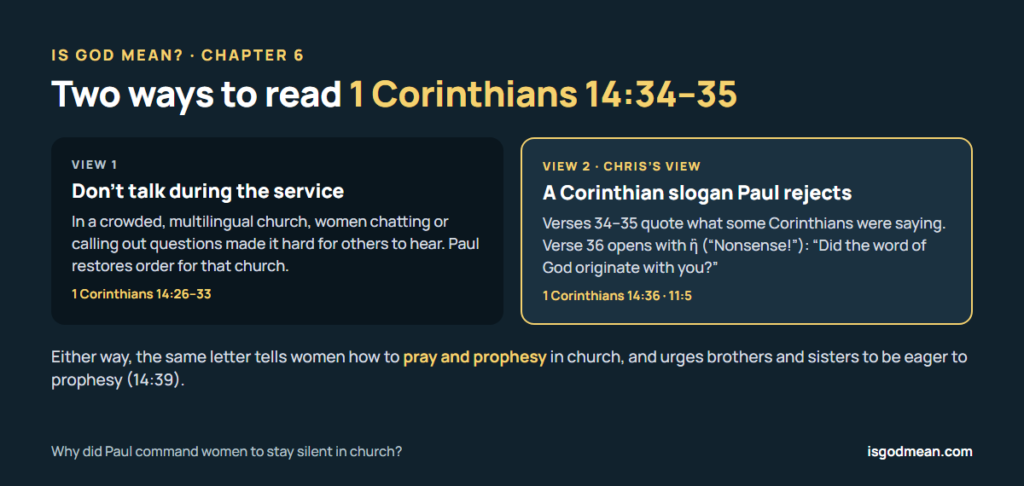
I tend to agree with the scholars who hold this position, as it seems most consistent with the rest of the chapter, the entire Book of Corinthians, the Bible as a whole, and the original language in which it was authored. The Bible’s authors repeatedly go out of their way to empower women in the face of the misogynistic culture that existed during Bible times, so Paul using this opportunity to rebuke an oppressive mindset attempting to weed its way into the Corinthian church seems the most reasonable interpretation to me, and reveals yet again how God’s loving nature can be found in even the most challenging portions of scripture when you understand them as the author intended them to be understood.
Take it further
Get the free Is God Mean? study guide
A small-group session for every chapter, with discussion questions, Scripture and prayer. Sign up and you’ll be the first to know when the book releases.