Chapter 8 · Video coming soon
Is Predestination Biblical? Does God Predestine People for Hell?
Free will, a hardened heart, and the choice that’s still yours
In this chapter
“I will harden Pharaoh’s heart” (Exodus 7:3) has troubled believers for centuries. Does God create some people just to destroy them? Chris believes Scripture says no.
- God wants everyone to be saved. He “wants all people to be saved and to come to a knowledge of the truth” (1 Timothy 2:4).
- The sun hardens clay and melts ice cream. The sun treats both the same; the difference is in what it shines on. God’s love is the same toward everyone. Some hearts soften, and some harden.
- Pharaoh hardened his own heart first. Again and again, “Pharaoh hardened his heart” (Exodus 8:15, 32). Only after that did God strengthen Pharaoh’s resolve to do what was already in his heart, something scholars call “judicial hardening.”
- Romans 9 is about God’s choices in history, not anyone’s eternal destiny. God chose Isaac over Ishmael and Jacob over Esau for their roles in His plan, but He still blessed Ishmael. And His choices are never arbitrary.
- The choice is still yours. Romans 9 says God prepared the vessels of mercy for glory, but it never says He prepared anyone for destruction. He “bore with great patience” those who chose it.
Key takeaways
- No one is created for destruction. God wants everyone to be saved and to know the truth.
- God hardens only hearts that have already chosen to harden themselves. His sovereignty works with our choices; it doesn’t override them.
- The choice is yours. In Chris’s words: “You are not rejected. You have not been predestined for destruction… You are loved. You are chosen.”
Free study guide
Study this episode with your group
Discussion questions, Scripture, and a closing prayer for this chapter, free for any small group.
…I will harden Pharaoh’s heart…
God, Exodus 7:3 (KJV)
These words from God in Exodus 7 have perplexed many people over the ages. How can humanity have free will if God is hardening people’s hearts and controlling their actions? Does humanity really have free will, or are we all really just pawns in a divine game of chess? Are our actions being controlled by a greater force? Are the few of us who get selected for salvation just the winners of a lucky draw?
The scariest part of that idea is that there are people who are purposely excluded from salvation. Is there anything those people can do, or were they created just to be objects of God’s wrath? The idea that a person could be created just to experience God’s judgment seems absolutely terrifying, and seems the opposite of something a loving God would do.
So how do we reconcile this passage of scripture with the concept of an all-loving and all-good heavenly father? Well, I’m glad you asked, because that is exactly what we’re exploring in this chapter.
In this article
The Sun Hardens The Clay
I’m going to make two statements:
The sun hardens clay.
The sun melts ice cream.
Does the sun actively choose to harden the clay while simultaneously choosing to melt the ice cream? No, the sun is just doing what it always does. It is consistent, always giving everything under its rays the same treatment. However, the difference in the material encountering the sun causes it to react differently. It hardens clay, yet melts ice cream. The difference is not in the sun’s treatment, but in the reaction of the source material to the treatment.
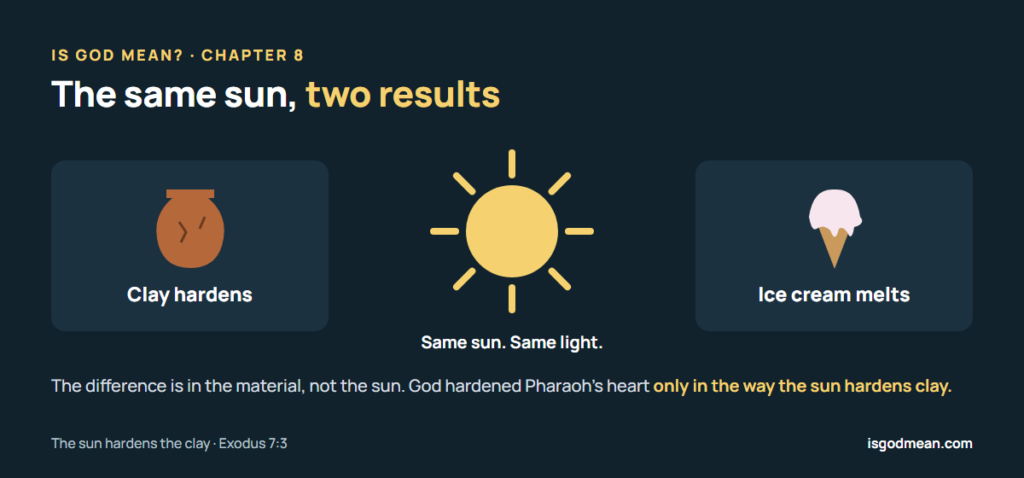
Likewise, God gives everyone the same treatment. He loves everyone and desires them to come to the knowledge of truth. The Bible explicitly tells us this:
This is good, and pleases God our Savior, who wants all people to be saved and to come to a knowledge of the truth.
1 Timothy 2:3-4 (NIV)
Yet, when some people encounter God’s nature, it hardens them. For others, it softens them. In Pharaoh’s case, the Pharaoh was unwilling to surrender his own power to a power even higher than his own. His pride hardened his heart. The idea of surrendering his will to another was repulsive to him. So yes, God hardened Pharaoh’s heart, but only in the way that the sun hardens clay.
In fact, when God says “I will harden his heart” in Exodus 4:21, and when we read that “the Lord hardened Pharaoh’s heart” in Exodus 9:12, the Hebrew word for “harden” is chazaq, which typically carries the idea of strengthening or fortifying something. (Exodus 7:3 uses a related word, qashah, “to make hard or stubborn.”) In this sense, it carries a meaning similar to curing concrete – hardening something to make it stronger. So, I think a more accurate understanding of these verses would be, “And God strengthened the Pharaoh’s resolve to do what was already in his heart.”
Pharaoh hardened his own heart
If you’re not familiar with the story of the Exodus of God’s people out of Egypt, let me catch you up to speed. There had been a great famine in Canaan, so Jacob and his sons had settled in Egypt, where Joseph (Jacob’s son who had been sold into slavery) had risen to power under Pharaoh. Joseph had stockpiled food in Egypt in preparation for the famine, and so he provided for his father and brothers in Egypt. While in Egypt, Jacob’s sons were fruitful and multiplied greatly in numbers.
Eventually Joseph and his brothers passed away, and a new King came to power in Egypt. This new Pharaoh knew nothing of Joseph, and the Israelites meant nothing to him. This new Pharaoh was concerned about the large number of Israelites living in Egypt, as he feared they would side with Egypt’s enemies if war ever broke out. So in an effort to subdue the Israelites he made them slaves and oppressed them. He even commanded all Israelite male babies be thrown into the Nile to die.
One baby, however, was rescued out of the Nile by an Egyptian princess. That baby was Moses. Moses grew up as an Egyptian. After he was grown, he killed an Egyptian who was abusing an Israelite slave. Out of fear, he runs from Pharaoh. However, while in Midian, God speaks to Moses and sends him to Pharaoh to deliver God’s people out of Egypt.
This is where the showdown between Pharaoh and God begins.
While God was detailing the instructions Moses was to follow while confronting Pharaoh, God also mentioned that He knew that the king of Egypt would not comply with God’s wishes. This is our first glimpse into the state of Pharaoh’s heart. It doesn’t say here that God hardened Pharaoh’s heart. It simply says that God knew what Pharaoh would do – not that God was forcing Pharaoh to do it.
In fact, throughout the story of Moses’ confrontation with Pharaoh, we read multiple times that Pharaoh hardened his own heart:
But when Pharaoh saw that there was relief, he hardened his heart and would not listen to Moses and Aaron, just as the Lord had said.
Exodus 8:15 (NIV)
And we see the same thing again a few verses later:
Then Moses left Pharaoh and prayed to the Lord, and the Lord did what Moses asked. The flies left Pharaoh, and his officials and his people; not a fly remained. But this time also Pharaoh hardened his heart and would not let the people go.
Exodus 8:30-32 (NIV)
It is not until after this point, when Pharaoh hardens his own heart, that we see God step in to fortify that resolve inside of Pharaoh. Before this, we did see God say that He already knew what Pharaoh would do (Exo 3:19), and we saw God say that, in the future, he would harden Pharaoh’s heart (Exo 4:21, 7:3), but it is not until Pharaoh actually makes his own decision to harden his heart that God steps in.
This highlights that even Pharaoh had free will to make the decision that he wanted to make. He DID make the decision he wanted to make. God then simply gave him strength to stick to his decision. The term used by scholars to define this type of action is “judicial hardening.”
Judicial hardening is a biblical concept where God actively hardens the hearts of people who have already become stubbornly rebellious, sealing them in their sinful state as a form of divine judgment. It is a response to persistent, willful resistance to God’s will and is often described as God allowing people to follow the path of their own sinful choices, which ultimately leads to their downfall. This process is seen as a just consequence for their actions, not an arbitrary act of imposing blindness on the innocent.
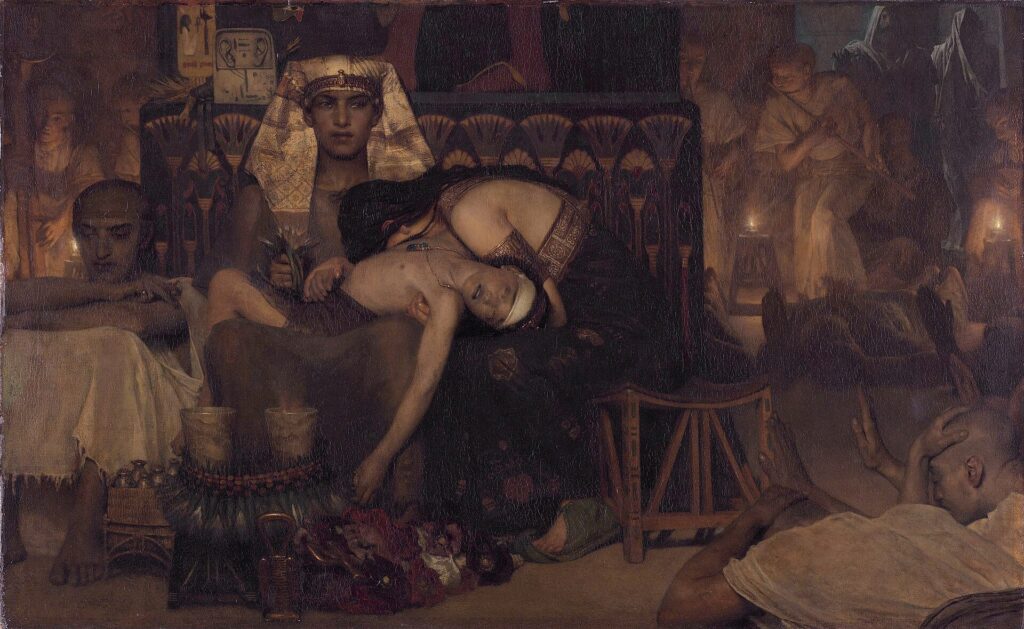
I believe the very nature of God’s request, that Pharaoh must submit his will to God’s, enraged Pharaoh’s exorbitant pride. I believe just the idea that someone would dare to give Pharaoh an order was enough to harden Pharaoh’s heart. Ultimately, I believe Pharaoh’s pride hardened his heart, and all God did was give Pharaoh the resolve to remain faithful to what was truly in his heart despite the intense pressure of the plagues. The results that followed were deserved and justified.
What does the New Testament say about it?
In Romans 9, Paul comments on the story of Pharaoh. This New Testament chapter of the Bible is one of the primary passages of scripture used to teach the idea that God creates some people who are predestined for Hell from before their birth. Before we dig into the chapter, I would highly recommend you go read the entire chapter of Romans 9, as I believe our discussion will make much more sense to you here if you are first familiar with the context.
Early on in the chapter, Paul starts explaining different moments in time where God “predestined” for someone’s life to go a certain direction or play out in a certain way. His first example is God’s selection of Isaac over Ishmael. In verses 6-9, Paul explains that although both children were biological sons of Abraham, God chose only Isaac to inherit the covenantal promise of blessings given to Abraham. This decision makes sense, however, because God’s promise had been that Abraham would have a son with Sarah his wife (not Hagar). This example highlighted that God honored obedience and faith over compromise and doubt.
This is the first example in Romans 9 of God sovereignly choosing, to an extent, what a person’s path in life would be despite any action taken on their part. This idea is then built upon when Paul moves on to Isaac’s sons, Jacob and Esau, highlighting that God chose Esau to serve Jacob before they were even born or capable of choosing right from wrong. This, once again, highlights God’s sovereignty in selecting predetermined plans for the boys.
…To Rebecca, also, a promise was made that took priority over genetics. When she became pregnant by our one-of-a-kind ancestor, Isaac, and her babies were still innocent in the womb—incapable of good or bad—she received a special assurance from God. What God did in this case made it perfectly plain that his purpose is not a hit-or-miss thing dependent on what we do or don’t do, but a sure thing determined by his decision, flowing steadily from his initiative. God told Rebecca, “The firstborn of your twins will take second place.” Later that was turned into a stark epigram: “I loved Jacob; I hated Esau.”
Romans 9:10-13 (MSG)
It’s important to note here that just because God recognized what was going to happen between the brothers does not mean that God caused it to happen. God foreknew the decisions Esau was going to make in life (forsaking his birthright), and God prepared his path for him accordingly. However, let’s put that point aside for a moment to focus on the point Paul is making here.
The story of God choosing Jacob over Esau highlighted that while God’s selection, at least in these examples, is not determined by your bloodline, it is also not determined by striving to force God’s favor. The boys had not even been born yet, and already God had assured Rebekah of their positions in life. This leaves one to wonder: what determines God’s selections?
God does what He wants
Paul answers that question with the next line in his letter, which is one of the most often quoted passages of scripture used to support the idea that God predestines some people for blessing, and others for wrath. In this passage, Paul references Pharaoh and how God used Pharaoh’s life to display the power of God to the earth:
Was God being unfair? Of course not. For God had said to Moses, “If I want to be kind to someone, I will. And I will take pity on anyone I want to.” And so God’s blessings are not given just because someone decides to have them or works hard to get them. They are given because God takes pity on those he wants to.
Romans 9:14-18 (TLB)
Pharaoh, king of Egypt, was an example of this fact. For God told him he had given him the kingdom of Egypt for the very purpose of displaying the awesome power of God against him, so that all the world would hear about God’s glorious name. So you see, God is kind to some just because he wants to be, and he makes some refuse to listen.
So this passage again highlights that whom God selects to show mercy to is not based on human desire or striving, but is a decision he makes based on His own omniscience and omnipotence – His sovereignty. It’s pretty clear that the message of this chapter is that God does whatever He wants, when He wants, how He wants, based on the knowledge that He alone possesses – including the thoughts and desires of all creation. However, I believe it is critically important to acknowledge that with all of these examples used to highlight God’s sovereignty, they are not examples directly relating to eternal salvation.
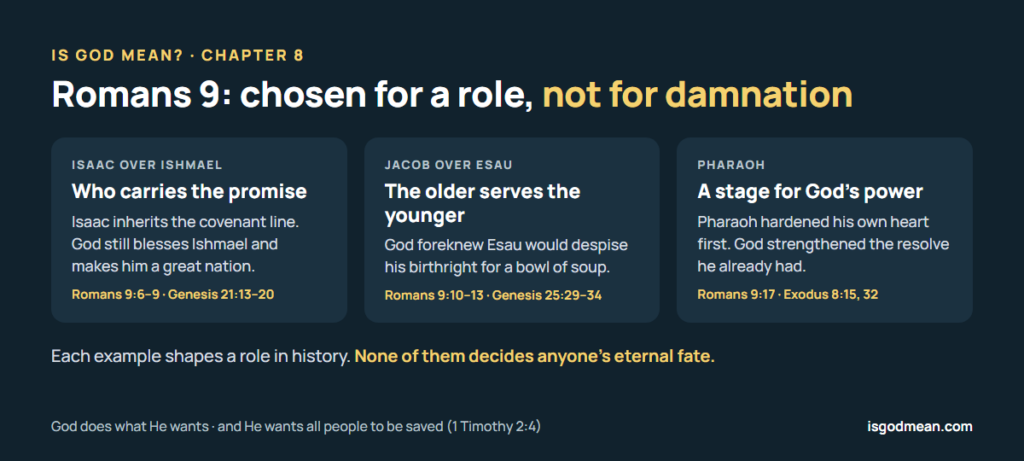
In the example of Isaac and Ishmael, God was selecting which child would receive the covenant blessings God had promised to Abraham. That did not mean that God was damning Ishmael or Ishmael’s descendants to Hell. God actually promised Abraham that He would bless Ishmael, greatly multiply him, and make him into a great nation. God told Ishmael’s mother, Hagar, the same thing. God then provided for Hagar and Ishmael, and the Scriptures tell us that God was with Ishmael. So while God selected Isaac, instead of Ishmael, to save the world (by sending Jesus through his line), God never abandoned Ishmael, and He certainly never predestined Ishmael to eternal damnation.
Likewise, with Jacob and Esau, God selected Esau to serve Jacob, but, again, that doesn’t mean Esau was predestined for eternal damnation. Also, the hardening of Pharaoh’s heart was after he had already hardened his own heart against God. There is no evidence that Pharaoh was predestined for Hell from his conception. Pharaoh made his own decisions, and God strengthened his resolve.
God’s selections are not arbitrary
So, do I believe that God makes sovereign selections that shape the course of people’s lives? Absolutely! We see clear examples of that in the Bible, but I do not think those sovereign selections extend into predetermining someone’s eternal fate before their conception, as we do not see Biblical examples of that. I also do not think that God’s sovereign selections are arbitrary. Let me explain.
God told Abraham he would receive a son through his wife, not a concubine, so of course God’s selection would rest with Isaac instead of Ishmael. God’s word to Abraham would have been broken had He not given Abraham a son through Sarah. With Esau, God, in his omniscience, foreknew that Esau would despise his birthright and not even see it as valuable as a single bowl of soup. Why would God want to choose someone who doesn’t value his birthright? I wouldn’t want to hand the covenant agreement, eventually responsible for redeeming the entire world, to someone who doesn’t care about it either.
As far as Pharaoh is concerned, if Pharaoh was already going to harden his heart against God and terrorize God’s chosen people, why not at least use him to spread the greatness of God throughout the earth in the process? God’s strengthening of Pharaoh’s hard heart highlights God’s ability to sovereignly steer even the most blatantly evil rulers toward His plan and goals. Even the most stubbornly rebellious leaders are no threat to God’s purposes for the earth.
What is my point? My point is that God’s sovereign selections are fair. God’s selections are just and represent what people deserve. His divine selections do not involve removing a person’s free will, but only involve making sovereign selections that divinely shape the events and positions of people’s lives on earth, not in eternity. Even then, those selections are based on what people deserve.
For instance, God foreknew that Pharaoh would harden his heart in rebellion. So, because of the decisions Pharaoh would make using his God-given free will, Romans 9:17 makes it clear that God, in His sovereignty, placed him as the ruler of Egypt to take advantage of Pharaoh’s choices to proclaim God’s power to the world.
What does God want?
I won’t deny that Romans 9 screams “God does what He wants!” So, then, I think the all-important question we have to ask ourselves is, “What does God want?” Thankfully, the Bible is not ambiguous about what God wants. Especially when it concerns His desire for our eternal souls. This verse makes it clear:
This is good, and pleases God our Savior, who wants all people to be saved and to come to a knowledge of the truth. For there is one God and one mediator between God and mankind, the man Christ Jesus, who gave himself as a ransom for all people. This has now been witnessed to at the proper time.
1 Timothy 2:3-6 (NIV)
Without question, this verse tells us that God desires all people to be saved, and that Christ gave Himself as a ransom for ALL people. So, yes, Romans 9 tells us that God, in His sovereignty, does whatever He wants, but the rest of the Bible shows us that what He wants is for the whole world to be saved. With this in mind, let’s continue walking through Romans 9:
But who are you, a human being, to talk back to God? “Shall what is formed say to the one who formed it, ‘Why did you make me like this?’” Does not the potter have the right to make out of the same lump of clay some pottery for special purposes and some for common use?
Romans 9:20-21 (NIV)
This passage is again highlighting that God has the right to use some people’s lives for special purposes and some for common use, in whatever way He sees fit. However, once again, other portions of Scripture reveal that God’s selections are not arbitrary, but based on the decisions we make. While Romans 9 tells us that God uses some lumps of clay for common use and others for noble purposes, the following scripture reveals that there is a standard God uses for choosing how each lump of clay is used:
In a large house there are articles not only of gold and silver, but also of wood and clay; some are for special purposes and some for common use. Those who cleanse themselves from the latter will be instruments for special purposes, made holy, useful to the Master and prepared to do any good work.
2 Timothy 2:20-21 (NIV)
The same author who wrote the passage in Romans 9 about the potter having the right to use some clay for special purposes specifies in 2 Timothy that it is the vessels that cleanse themselves that will be prepared for good works. In this way, God leaves it up to us to choose whether we will be used for good works or not.
Who prepared who for destruction?
So, Romans 9 is very clear that God will show mercy and favor to whomever He wants to show mercy and favor to. However, the rest of Scripture makes it clear that God wants to show mercy and favor to everyone! However, while He desires to show mercy and favor to everyone, He won’t force His will on those who insist on resisting it. Like Pharaoh, God has a use for those who harden their hearts against Him. Pharaoh chose to rebel against God, and so God set him aside as a vessel for common use. Continuing through Romans 9, we see that Pharaoh’s common use was to make God’s power known:
What if God, although choosing to show his wrath and make his power known, bore with great patience the objects of his wrath—prepared for destruction? What if he did this to make the riches of his glory known to the objects of his mercy, whom he prepared in advance for glory— even us, whom he also called, not only from the Jews but also from the Gentiles?
Romans 9:22-24 (NIV)
Notice that this passage says that God bore with great patience those who were prepared for destruction. That would be a very confusing verse if God was the one preparing them for destruction. Why would you have to patiently endure something doing exactly what you made it to do? You don’t “endure” things behaving exactly as you intended. You enjoy them. You only patiently endure things that are NOT going the way you want them to. Likewise, God is patiently enduring those who have prepared themselves for destruction because they are not behaving in the way He desires them to.
Why do I say they “prepared themselves” for destruction? Well, because in the passage there are two distinct groups of people mentioned. Those prepared for destruction, and those prepared in advance for glory. Notice that when referring to those prepared in advance for glory, it specifically says that God is the one who prepared them for glory. Contrast that against the fact that it does not say that God is the one who prepared the other group for destruction. It simply says that they were prepared for destruction, and that God endured them patiently.
When you study the original Greek, there have been many debates about whether the perfect middle/passive participle should be translated as ‘having prepared themselves for destruction’ or ‘having been prepared for destruction’. Either way, the original Greek does not include God in their preparation for destruction. Conversely, the grammar does actively include God in the preparing of the other group for glory!
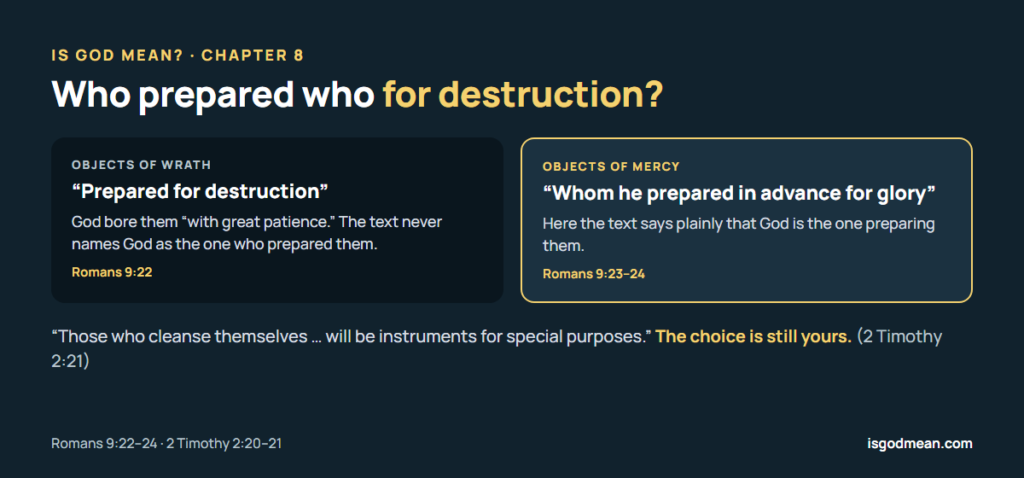
Those prepared for destruction are the ones who did not choose to cleanse themselves from wickedness. They are the wood and clay reserved for common use, like Pharaoh was. Not because God forced them to be that, but because they chose to be that while God patiently endured their opposition to His desire for their lives.
A divine game of chess?
So, is God playing a divine game of chess with us? Yes… and no. God is moving people into positions and places in order to cause everything to work together for the good of those that love Him and have been called according to His purpose (Romans 8:28). He is not forcing, or preventing, anyone from making the choice to love Him, but He is working with their choice to position people in the right place to ultimately push His story line towards its finish. I am grateful that I get to choose whether or not I get to be one of the main characters in His story, and that He leaves the decision to be an object of His mercy, whom He is preparing for glory, in my hands.
My friend, the decision is yours today. If you haven’t already, make the choice to follow Jesus, as the choice truly is in your hands. Your reading this is not an accident, and God is calling you into His family. You are not rejected. You have not been predestined for destruction. On the contrary, the Bible says you were the focus of His love even before the foundations of the earth were laid. No matter who you are, you have been the object of God’s affection and pursuit since before the world began. If you haven’t already, it’s time to yield to His love and let it overtake you and satisfy you. You are loved. You are chosen.
I leave you with this verse that explains how you have been predestined for sonship and love because you bring pleasure to God.
Praise be to the God and Father of our Lord Jesus Christ, who has blessed us in the heavenly realms with every spiritual blessing in Christ. For he chose us in him before the creation of the world to be holy and blameless in his sight. In love he predestined us for adoption to sonship through Jesus Christ, in accordance with his pleasure and will— to the praise of his glorious grace, which he has freely given us in the One he loves.
Ephesians 1:3-6 (NIV)
Take it further
Get the free Is God Mean? study guide
A small-group session for every chapter, with discussion questions, Scripture and prayer. Sign up and you’ll be the first to know when the book releases.